

Why Your Acne Isn't Improving | Glow Reset
Look Good. Travel Far. Live Well ◆ Skincare & Beauty by Mijung | K- Beauty & Flight Attendant Experience
I. introduction: Acne Isn't Improving
If your acne isn’t improving, the natural reaction is to assume your skincare routine isn’t doing enough.
So another cleanser gets added. Then an exfoliant. Maybe a stronger acne treatment, a new serum, or the product everyone online suddenly seems to recommend. When breakouts continue, it’s easy to believe the answer must be something stronger or another product entirely.
Sometimes, the opposite may be true.
Acne-prone skin can become caught in a cycle of cleansing, treating, exfoliating, and switching products so frequently that the routine itself becomes difficult for the skin to tolerate. Irritation, dryness, and a compromised skin barrier can exist alongside acne, making it harder to understand what’s helping and what’s making things worse.
That doesn’t mean acne is simply caused by using the wrong skincare. Hormones, genetics, medications, stress, and other factors can all play a role, and persistent or severe acne may require professional treatment.
But the skincare routine is one place where we have some control.
Instead of immediately asking, What should I add?, it can be more useful to look at everything already touching your skin. How often are you cleansing? How many active ingredients are being layered together? Are products changing every few weeks? Is your skin frequently tight, dry, burning, or irritated?
Sometimes a reset isn’t about doing nothing.
It’s about removing some of the noise so you can build a gentler, more consistent routine and better understand what your skin actually needs.
Quick Guide
In this guide, we’ll explore:
- The point where a complicated acne routine can become counterproductive
- Skin-barrier health and acne-prone skin
- Constant product switching and inconsistent routines
- Over-cleansing and unnecessary irritation
- Balancing acne treatments with recovery and hydration
- Everyday habits that can affect acne-prone skin
- Simplifying a routine without abandoning effective acne care
- Products we use and recommend for a thoughtful Glow Reset routine
- The Glow Reset Planner for building greater skincare consistency
- Signs that it’s time to speak with a dermatologist
This Guide Is For…
This guide is for anyone frustrated by recurring breakouts despite putting real effort into their skincare routine, especially when adding more products and treatments doesn’t seem to be getting them any closer to calmer skin.
It’s also for people whose acne-prone skin has become dry, sensitive, irritated, or overwhelmed by a complicated routine and those who simply aren’t sure anymore which products are helping.
The goal isn’t perfect skin overnight or another aggressive acne routine. It’s to take a more thoughtful look at what you’re already doing, simplify where it makes sense, and give consistency a chance to work.
Sometimes the first step forward is figuring out what your skin doesn’t need.

II. When More Skincare Becomes Too Much
When breakouts keep appearing, adding another product can feel like taking action.
The problem is that acne routines can become complicated quickly. A cleanser for oily skin gets followed by an exfoliating toner, an acne treatment, another serum, and perhaps a spot treatment before moisturizer. Individually, some of those products may have a legitimate purpose. Used together too aggressively, however, they can leave skin dry, irritated, tight, or uncomfortable.
That’s when it becomes difficult to tell what the skin is actually responding to.
I think this is one of the easiest traps to fall into with skincare. When something isn’t working fast enough, our instinct is often to do more. Yet skin doesn’t necessarily respond better simply because we’re using more active ingredients or treating it more frequently.
A better approach is to give every product in the routine a reason to be there. What is it supposed to accomplish? Is another product already doing essentially the same job? More importantly, how does your skin actually feel after using everything together?
If the answer is frequently dry, tight, stinging, burning, or unusually sensitive, adding another treatment may not be the best next move.
Sometimes the routine needs editing before it needs expanding.

III. Acne Isn't Improving? Look at Your Skin Barrier
The skin barrier doesn’t get nearly as much attention as breakouts do, but it deserves a place in the conversation.
The outermost layer of our skin helps retain moisture while protecting against the outside environment. When that barrier is disrupted, skin can become dry, irritated, sensitive, flaky, or uncomfortable. Acne and barrier problems can also exist at the same time, which creates an especially frustrating situation: you’re trying to treat the breakouts while your skin is telling you it needs gentler care.
If your acne isn’t improving and your face regularly feels tight after cleansing, stings when moisturizer is applied, suddenly reacts to familiar products, or stays unusually dry despite moisturizing, it’s worth paying attention to those signals.
That doesn’t mean stopping every acne treatment automatically. Effective ingredients can still have an important role. The goal is to avoid treating acne so aggressively that supporting the rest of the skin gets forgotten.
A simpler routine may mean using a gentle cleanser, appropriate moisturizer, daily sunscreen, and acne treatments at a frequency your skin can tolerate rather than layering several strong products simply because they’re available.
Healthy-looking skin isn’t only about eliminating blemishes. It also needs to remain comfortable, hydrated, and resilient enough to perform its normal protective job.
Before asking what stronger treatment to add next, sometimes it’s worth asking a different question:
How is my skin actually doing underneath the breakout?
⭐ Recommended Reading
IV. The Problem With Constantly Changing Products
When a new product promises clearer skin, giving it a try can be tempting—especially when the current routine doesn’t seem to be working.
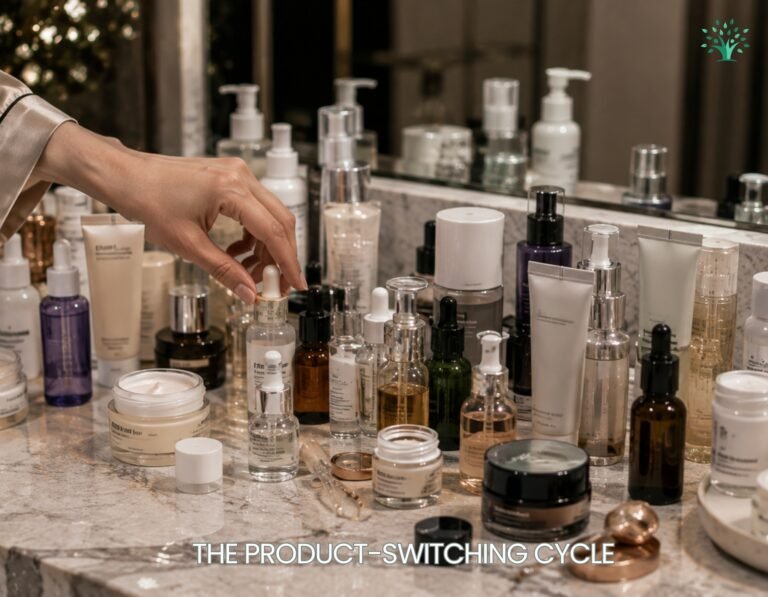
The trouble begins when products change so frequently that nothing gets a fair chance. One week it’s a new cleanser, the next it’s an exfoliant, and soon another serum replaces the one that was just introduced. If the skin improves, breaks out, becomes irritated, or feels unusually dry, figuring out which change was responsible becomes almost impossible.
Skincare also takes time. Some proven acne treatments may require several weeks of consistent use before meaningful improvement becomes noticeable. Switching too quickly can interrupt that process and create a cycle where the routine is constantly starting over.
Introducing several new products at once creates another problem. If irritation or breakouts appear, there is no easy way to identify the cause. Changing one thing at a time and paying attention to how the skin responds may not be exciting, but it gives you much better information.
When acne isn’t improving, consistency can be more useful than constantly searching for the next promising bottle.
A good routine doesn’t need to be new every month. It needs to be appropriate for your skin, tolerable enough to use consistently, and given enough time to show whether it’s actually helping.
⭐ Recommended Reading
V. Over-Cleansing Can Work Against Your Skin
Acne can create a strong urge to make the skin feel completely clean.
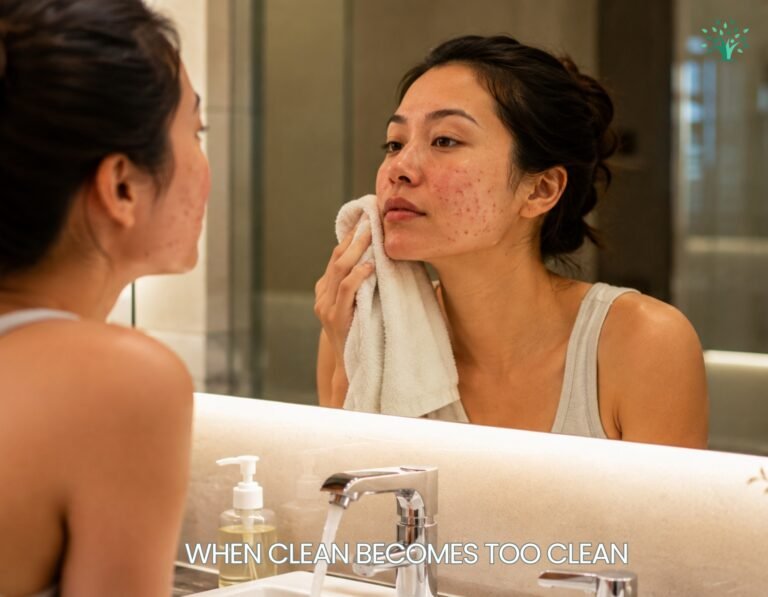
That can lead to washing more frequently, scrubbing harder, using very hot water, or choosing cleansers that leave the face feeling almost squeaky afterward. That sensation may feel satisfying for a moment, but tighter and drier doesn’t necessarily mean cleaner or healthier.
Cleansing has an important job: removing excess oil, sunscreen, makeup, sweat, and everyday buildup without unnecessarily disrupting the skin. When cleansing becomes too aggressive, irritation and dryness can follow, particularly when the routine already contains acne treatments or exfoliating ingredients.
This is where gentle can sometimes be more effective than aggressive. Lukewarm water, a mild cleanser, and using your fingertips rather than scrubbing tools may be enough for everyday cleansing. Afterward, the skin should feel clean without feeling stripped.
It’s also worth remembering that acne isn’t evidence of poor hygiene. Washing the face repeatedly won’t address every reason breakouts develop, and treating acne-prone skin as though it simply isn’t clean enough can create unnecessary irritation.
The goal isn’t to scrub acne away.
It’s to cleanse well enough that the treatments and supportive products in the rest of the routine can do their jobs without asking already-stressed skin to recover from the cleansing step first.
⭐ Recommended Reading

VI. Active Ingredients Need Balance
Acne treatments can be effective precisely because they do something meaningful to the skin. Ingredients such as salicylic acid, benzoyl peroxide, and retinoids can play an important role in acne care, but using several strong treatments together doesn’t automatically produce faster results.
Sometimes it produces more irritation.
It’s easy to build a routine where nearly every step is trying to treat the same problem. An exfoliating cleanser is followed by an acid toner, then an acne serum, a retinoid at night, and a spot treatment whenever another breakout appears. Before long, there isn’t much in the routine focused on simply supporting the skin.
The better question isn’t necessarily which active ingredient is strongest. It’s whether the overall routine is balanced enough to be used consistently. Moisturizer, gentle cleansing, sun protection, and recovery aren’t the unimportant parts surrounding the acne treatment; they’re part of creating a routine the skin can tolerate.
If burning, peeling, persistent redness, or sensitivity begins appearing, don’t assume discomfort proves the treatment is working. Those can be signs that the routine needs to be reconsidered.
Effective skincare doesn’t have to feel aggressive to be effective.

VII. Your Everyday Habits Matter Too
Skincare gets most of the attention because it’s the part we can see sitting on the bathroom counter. Acne, however, isn’t influenced only by what comes out of a bottle.
Hands touch the face throughout the day. Pillowcases collect oil, sweat, and product residue. Phones come into contact with the skin. Makeup brushes and applicators need regular cleaning, and going to bed without removing makeup or sunscreen can add another layer of buildup.
Stress and sleep deserve attention as well. Neither should be treated as a simple explanation for every breakout, but our daily routines affect much more than our skin. Building healthier habits around sleep, stress management, movement, and general wellness supports the bigger picture even when there isn’t an overnight change in the mirror.
The goal isn’t to become obsessive about everything that might touch your face. That can make skincare more stressful than it needs to be. Instead, focus on the obvious habits that are easy to overlook: remove makeup before bed, keep frequently used items reasonably clean, avoid constantly picking at blemishes, and pay attention to patterns when breakouts repeatedly appear.
Sometimes the useful clues aren’t inside the skincare cabinet at all.

VIII. When Acne Isn't Improving, Simplify
When acne isn’t improving, the temptation is usually to search for something new. A reset asks us to do almost the opposite: look carefully at what we’re already using and decide what actually deserves to stay.
Start with the foundation. A gentle cleanser, moisturizer appropriate for your skin, daily sunscreen, and a proven acne treatment can create a much clearer routine than a counter crowded with overlapping products. From there, additional products should have a purpose rather than simply being added because they’re popular.
Simplifying also makes it easier to observe your skin. If five products change at the same time, improvement or irritation becomes difficult to trace. A stable routine gives you a better baseline and makes future adjustments more deliberate.
This doesn’t mean abandoning treatments prescribed or recommended by a dermatologist, nor does it mean that a minimalist routine will resolve every form of acne. Persistent, painful, scarring, or worsening acne deserves professional attention rather than endless experimentation at home.
For everyone else caught in the cycle of adding, switching, exfoliating, and starting over, simplifying can provide something skincare routines often lack: consistency.
Give the skin fewer variables. Pay attention to how it responds. Make changes thoughtfully rather than emotionally, and allow appropriate treatments enough time to work.
A Glow Reset isn’t about giving up on your skin.
It’s about creating enough clarity to understand it better.

IX. Products We Use & Recommend when Acne Isn't Improving
When acne-prone skin already feels overwhelmed, adding more products isn’t necessarily the answer. I prefer a routine where each product has a clear purpose—hydration, calming support, barrier care, or daily sun protection—without making the routine unnecessarily complicated.
These are some of the products we use and recommend as part of a more thoughtful Glow Reset routine.
Torriden DIVE-IN Toner
A lightweight hydrating toner that fits easily into a routine when the goal is adding moisture without making skincare feel heavy or complicated.
Mixsoon Bean Essence
A simple essence that can add hydration and help support smoother-looking skin while keeping the routine relatively streamlined.
Skin1004 Madagascar Centella Ampoule
A lightweight centella-focused ampoule that works particularly well when the routine needs a calming, uncomplicated hydration step.
Dr. Jart Ceramidin Skin Barriers Cream
A richer moisturizer focused on supporting moisture retention and the skin barrier, especially useful when skin begins feeling dry or stressed.
Medi-Peel Peptide 9 Volume Bio Tox Cream
A nourishing cream we use when the routine calls for additional moisture and a richer finishing step.
Beauty of Joseon Relief Sun SPF 50+
Daily sun protection that completes the morning routine and becomes particularly important when using skincare ingredients that can leave skin more sensitive to sunlight.
Not every product belongs in every routine, and acne-prone skin doesn’t need all of these layered together. The point of a Glow Reset is to choose what your skin actually needs and build from there rather than assuming more products will produce better skin.
As an Amazon Associate, I earn from qualifying purchases. These are products we personally use and recommend because they support a simple, consistent approach to skincare without making the routine unnecessarily complicated.



ix. Glow Reset Planner
One thing dark spots taught me is how easy it is to make skincare more complicated than it needs to be.
When progress feels slow, we start adding things. Another serum, another active ingredient, another step that promises to work faster. Before long, it becomes difficult to tell what’s helping, what’s causing irritation, or whether we’ve given anything enough time to work.
That’s one of the reasons we created the Glow Reset Planner.
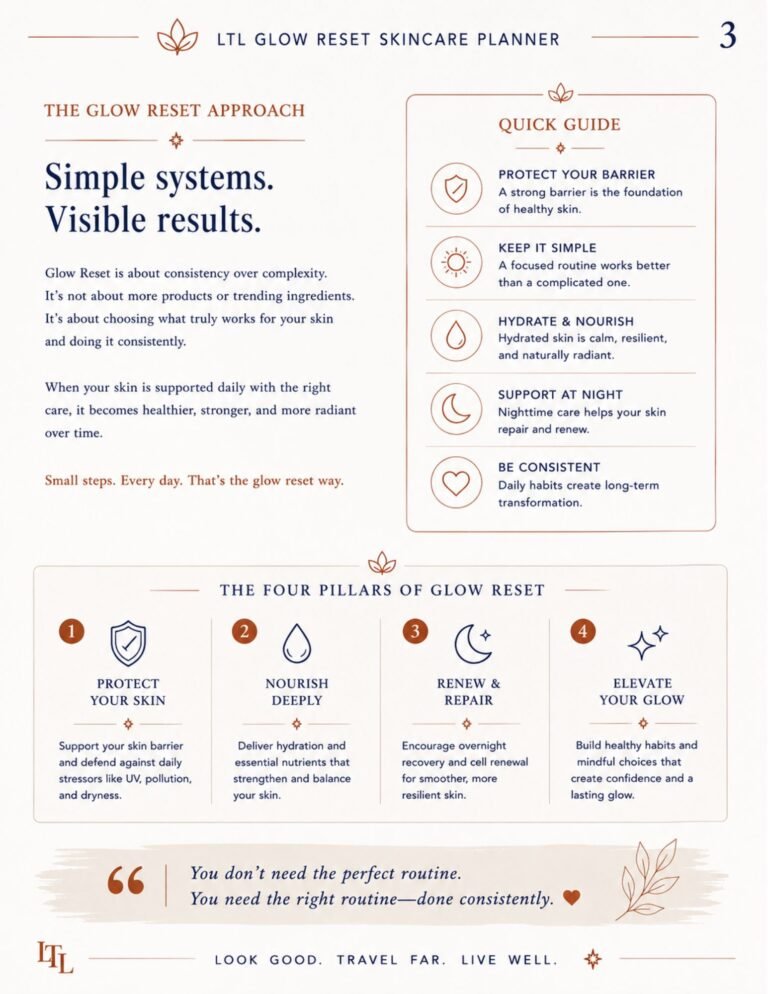
The planner provides a practical framework for taking a closer look at your skincare routine, supporting hydration and the skin barrier, and building daily habits that are easier to maintain. For stubborn pigmentation especially, that consistency can matter more than continually changing products.
Inside, you’ll find guidance and planning pages focused on daily skincare, hydration, skin-barrier support, recovery, product routines, healthy lifestyle habits, and creating greater consistency without making skincare unnecessarily complicated.
👉 Get your complimentary “Glow Reset Planner” 4-Page Sampler. Click here to download.
A selected preview from the complete planner to help you simplify your routine, track what you’re actually doing, and give your skin enough consistency to see what may be working.
🛍 If you’d like to continue, the complete Glow Reset Planner is a 24-page premium LTL Living Guide designed to help you build a more thoughtful skincare routine, support healthier daily habits, and stop feeling as though you need to start over every time your skin changes.
Sometimes a reset isn’t about doing more. It’s about figuring out what your skin actually needs.

XI. When It's Time to See a Dermatologist
There comes a point when changing the skincare routine isn’t enough.
If acne is painful, deep, persistent, worsening, leaving scars or dark marks, or affecting how you feel about yourself, talking with a dermatologist can be far more useful than continuing to experiment with products on your own. The same applies when you’ve followed a consistent routine for a reasonable amount of time and still aren’t seeing meaningful improvement.
A dermatologist can also help determine whether something beyond everyday skincare may be contributing to the breakouts. Hormonal changes, certain medications, and different forms of acne may require approaches that aren’t available from the skincare aisle.
Professional treatment doesn’t mean you’ve failed to take care of your skin. Sometimes it’s simply the appropriate next step.
The important thing is knowing when to stop chasing another product and start looking for a better answer.

XII. Clearer Days. Glow reset | Final Thoughts
When acne isn’t improving, it’s easy to believe you’re one product away from finally finding the answer.
Maybe sometimes you are. But sometimes the better move is to stop adding, step back, and look at the routine as a whole.
Is the skin being cleansed too aggressively? Are too many active ingredients competing for space? Are products changing before they’ve had enough time to work? Is the skin barrier showing signs of irritation? Or has the acne reached the point where professional care makes more sense than another round of trial and error?
There isn’t one routine that works for everyone, and there certainly isn’t one product that solves every breakout. What we can do is make skincare more deliberate: use products for a reason, introduce changes thoughtfully, support the skin as well as treat it, and give consistency enough time to tell us something useful.
Clearer skin may take patience. Just as important, healthier-looking skin shouldn’t require constantly fighting against it.
Sometimes progress begins not with another bottle, but with understanding what your skin has been trying to tell you.
CLEARER DAYS. GLOW RESET.
With care,
Mijung