
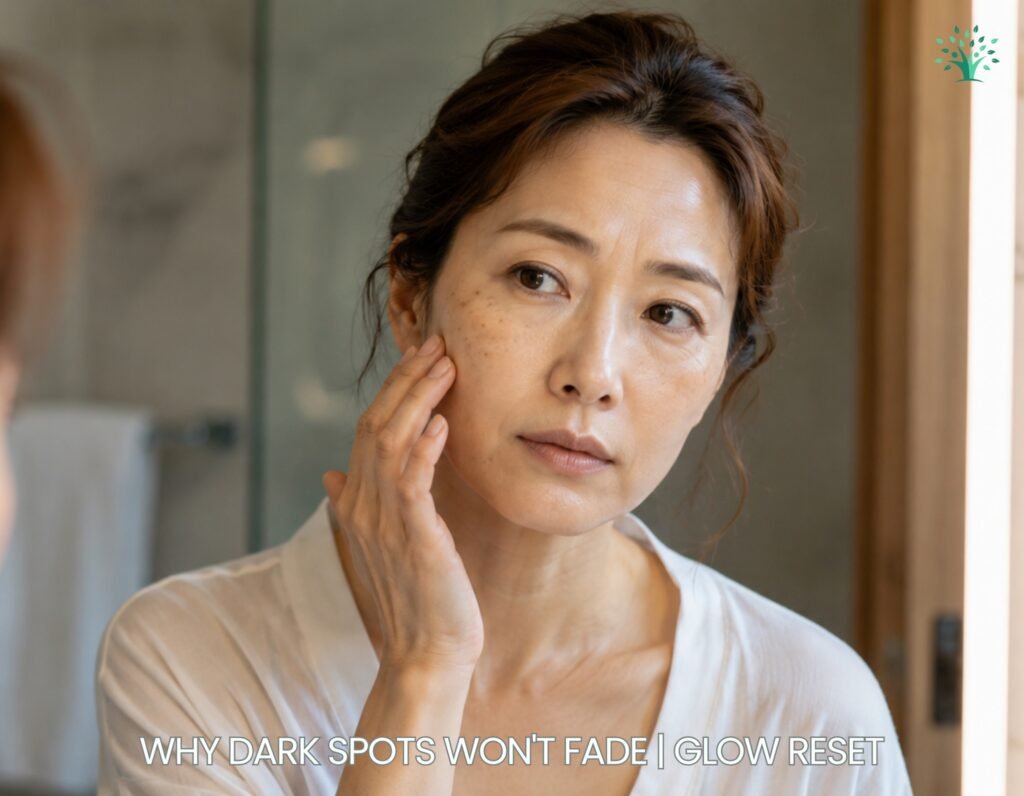
Why Dark Spots Won't Fade | Glow Reset
Look Good. Travel Far. Live Well ◆ Skincare & Beauty by Mijung | K- Beauty & Flight Attendant Experience
I. introduction: Dark Spots Won't Fade
Dark spots won’t fade as quickly as most of us would like, and I understand how frustrating that can be.
A breakout finally clears, but the mark it leaves behind seems to stay for months. Or we begin noticing areas of uneven pigmentation that weren’t there a few years ago. We try a brightening serum, add an exfoliant, perhaps switch products again, and keep checking the mirror waiting for something to change.
I’ve learned that dark spots are one of those skin concerns where doing more doesn’t always mean seeing results faster.
Part of the problem is that we tend to treat every brown mark as though it’s the same thing. It isn’t. Some discoloration develops after acne or inflammation. Other spots are connected to years of sun exposure, and pigmentation can become more noticeable as our skin changes with age. What looks similar in the mirror may have a very different reason for being there.
Then there is everything we do while trying to make the spots disappear.
We may use several brightening ingredients at once, exfoliate more often, or become so focused on treating existing pigmentation that we overlook one of the most important parts of the routine: protecting the skin from additional sun exposure. If irritation develops along the way, we’re potentially creating another problem while trying to correct the first one.
That doesn’t mean dark spots can’t improve. Many can gradually become less noticeable with the right approach, but pigmentation usually asks something of us that skincare marketing doesn’t emphasize very often.
Patience.
Before reaching for another brightening product, it helps to understand what kind of discoloration we’re looking at, what may be keeping it visible, and whether our current routine is actually supporting the progress we’re trying to make.
That’s where I would start.
Quick Guide
In this guide, we’ll look at:
- Why different types of dark spots need different approaches
- The connection between sun exposure and persistent pigmentation
- How acne and inflammation can continue creating new marks
- Why aggressive exfoliation may work against the skin
- Brightening ingredients and the importance of consistency
- Realistic expectations for visible improvement
- When pigmentation should be evaluated by a dermatologist
- Products we use and recommend for a thoughtful Glow Reset routine
- The Glow Reset Planner for building a simpler, more consistent skincare routine
This Guide Is For…
This guide is for anyone who keeps looking in the mirror and wondering why the same spots are still there despite putting real effort into their skincare.
It’s especially useful if you’ve been dealing with marks left after breakouts, uneven-looking skin tone, visible sun-related pigmentation, or a routine that has slowly accumulated more brightening products without delivering the improvement you expected.
We’re not going to promise spotless skin in seven days or suggest that one miracle ingredient makes pigmentation disappear.
The goal is much more practical: understand what you’re treating, protect the progress your skin is making, choose products with a purpose, and give a good routine enough consistency to work.
With dark spots, slower progress is still progress.

II. Not All Dark Spots Are the Same
One of the first things I learned about pigmentation is that the words dark spots can describe several different skin concerns.
After acne, many of us are left with flat brown, tan, or grayish marks where the blemish used to be. This is often post-inflammatory hyperpigmentation, or PIH. The breakout may be gone, but the skin continues producing extra pigment in response to the inflammation that happened there.
Sun exposure creates another pattern. Years of ultraviolet exposure can gradually show up as areas of uneven pigmentation, particularly on the face, hands, chest, and other places that receive regular sun. These spots may become more noticeable with age, even though some of the damage behind them began much earlier.
Melasma is different again. It often appears as larger, more symmetrical patches of pigmentation, commonly across the cheeks, forehead, nose, or upper lip, and can be influenced by hormones as well as sun and visible light. That isn’t something I would treat as simply another stubborn sun spot.
This distinction matters because the product that helped fade a mark left by a breakout may not be the right answer for every patch of pigmentation we see.
Before trying to make a dark spot disappear, I think the better first question is: What am I actually trying to treat?
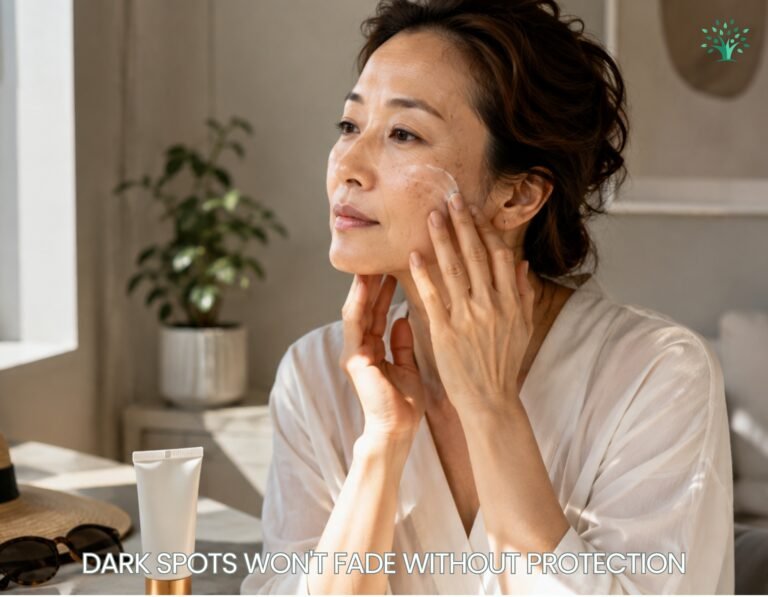
III. Dark Spots Won't Fade Without Sun Protection
We can spend a surprising amount of money trying to brighten pigmentation while overlooking the product that helps protect all that effort.
Sunscreen.
When dark spots won’t fade, ongoing sun exposure deserves attention because ultraviolet light can stimulate pigment production and make existing discoloration more noticeable. Even a carefully chosen brightening routine has a harder job if the skin continues receiving unprotected exposure day after day.
This became more important to me as I got older. Sun protection isn’t only something to think about at the beach or on vacation. Driving, walking, sitting near bright windows, gardening, and simply going through an ordinary day can add to our cumulative exposure over time.
For pigmentation-prone skin, I prefer thinking of sunscreen as part of the treatment strategy rather than the last optional step of a morning routine. Broad-spectrum protection, applied generously and reapplied when appropriate, helps protect the progress we’re trying to make.
Hats, shade, and being thoughtful about strong midday sun can help too. Skincare doesn’t have to carry the entire responsibility by itself.
A brightening serum may help address what we already see.
Sun protection helps us avoid continually working against it.
⭐ Recommended Reading

IV. Inflammation Keeps Leaving New Marks
Sometimes it seems as though a dark spot never improved when something else is actually happening: new marks keep joining the old ones.
This is particularly common with acne-prone skin. One blemish begins fading, another appears nearby, and suddenly the area looks as though nothing has changed. Picking or squeezing can make matters worse by adding more inflammation and trauma to skin that’s already trying to recover.
Irritation from skincare can become part of the cycle too. When we’re frustrated by pigmentation, it’s tempting to attack it with stronger acids, more exfoliation, or several active ingredients at once. But skin that is repeatedly irritated isn’t necessarily being given the best environment to recover.
That’s why I don’t look only at the individual spot. I look at what keeps happening around it.
Are breakouts still frequent? Is the skin regularly red or irritated? Are blemishes being picked? Does the routine leave the face burning, tight, or uncomfortable?
If new inflammation keeps creating new discoloration, fading the older marks can feel like trying to empty a bathtub while the water is still running.
Sometimes improving the appearance of dark spots starts with something less glamorous than another brightening serum:
Stop giving the skin new reasons to make them.
⭐ Recommended Reading
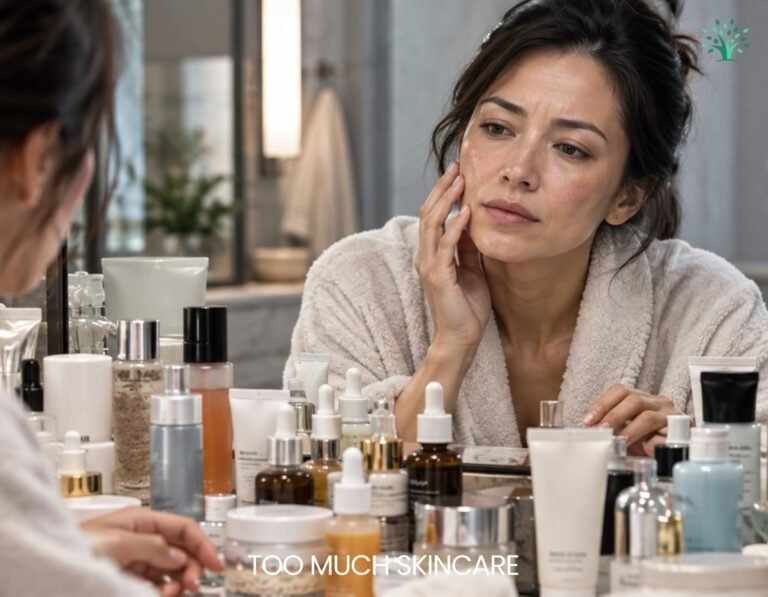
V. Too Much Skincare Can Slow Progress
When a dark spot has been sitting in the same place for months, patience isn’t always my first instinct either. It’s very easy to think that if one exfoliating acid helps, using it more often—or adding another active ingredient—must help even more.
Skin doesn’t always cooperate with that logic.
Exfoliating ingredients can be useful in a well-designed routine, and some active ingredients can help improve the appearance of uneven pigmentation over time. The problem begins when we’re using so many of them that the skin never gets a chance to feel comfortable.
For me, tightness, persistent redness, stinging when applying normally gentle products, unusual flaking, or suddenly becoming sensitive to products I’ve used before are signs to pay attention to. Those aren’t signals that a treatment is “working harder.” They may mean the routine has become too aggressive.
This is where supporting the skin barrier becomes especially important. A gentle cleanser, adequate hydration, a moisturizer that helps keep the skin comfortable, daily sunscreen, and carefully chosen treatment products may look less impressive on the bathroom counter, but simplicity can make consistency much easier.
The goal isn’t to make skin peel until the pigmentation disappears.
It’s to create a routine the skin can tolerate long enough to actually see progress.
⭐ Recommended Reading
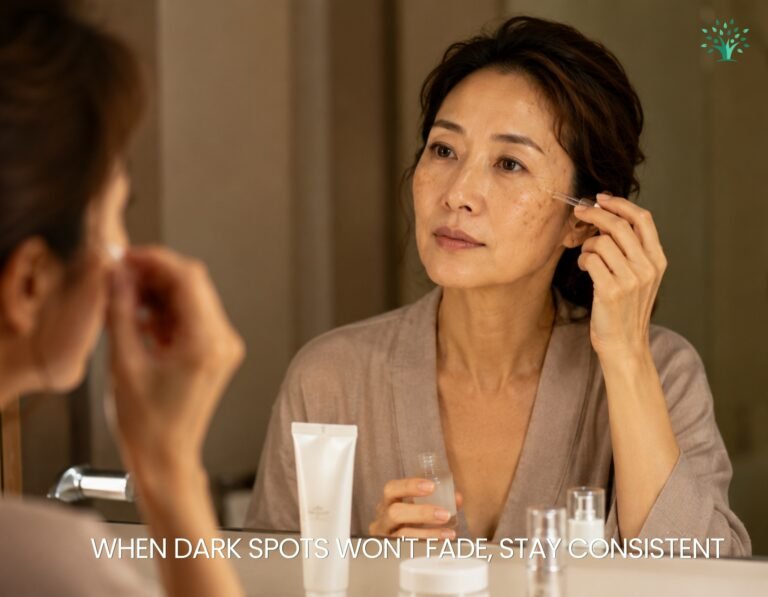
VI. When Dark Spots Won't Fade, Consistency Matters
When dark spots won’t fade, changing products every few weeks can make it difficult to know whether anything was given a fair chance to work.
There are several ingredients commonly used in routines for uneven-looking pigmentation. Niacinamide can be a gentle option for many skin types. Vitamin C is often used for antioxidant support and brightening. Retinoids can support skin renewal, while azelaic acid is another ingredient frequently considered when pigmentation occurs alongside acne or inflammation.
That doesn’t mean all of them need to go on the face at once.
I would rather build a routine around one or two appropriate treatment steps and use them consistently than keep introducing new products because progress looks slow. Which ingredients make sense—and how often they’re used—depends on skin type, sensitivity, the cause of the pigmentation, and what else is already in the routine.
It’s also important to give pigmentation realistic time. A mark created by inflammation doesn’t appear at the surface one morning and necessarily disappear the following week. Visible improvement can take weeks or months, and deeper or more persistent pigmentation may take considerably longer.
Photographs can sometimes be more useful than staring at the mirror every morning. Taking one in similar lighting every few weeks can make gradual changes easier to recognize.
With pigmentation, consistency isn’t exciting.
But it’s often much more useful than constantly starting over.
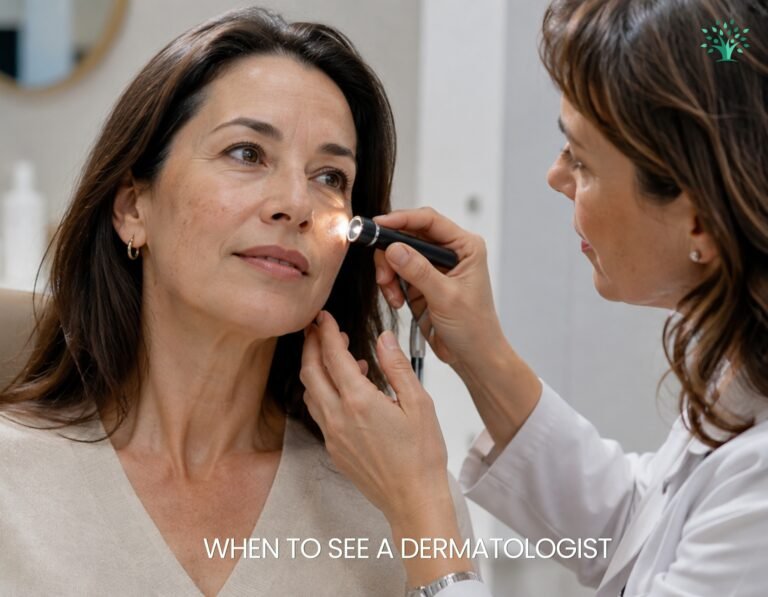
VII. Know When to See a Dermatologist
Not every dark area on the skin should automatically be treated as a cosmetic dark spot.
If pigmentation is new and unexplained, changing in size, shape, or color, looks noticeably different from other spots, bleeds, itches, becomes painful, or simply concerns you, I wouldn’t try to diagnose it from a skincare aisle or an article like this. That’s the time to have a dermatologist look at it.
Professional guidance can also be worthwhile when discoloration has persisted despite a consistent routine. A dermatologist can help determine whether you’re dealing with post-inflammatory hyperpigmentation, melasma, sun-related pigmentation, or something else entirely, and discuss treatments that aren’t available in an everyday skincare routine.
I also think there’s value in knowing when to stop experimenting.
Skincare can do a lot, but it shouldn’t become an endless cycle of buying stronger products because we’re frustrated with what we see in the mirror. Sometimes the smartest next product isn’t another product at all.
It’s an appointment with someone who can tell us what we’re actually looking at.

VIII. Products We Use & Recommend
When we’re trying to improve dark spots, adding more brightening products isn’t necessarily the answer. I prefer a routine where each product has a clear purpose—hydration, calming support, barrier care, or daily sun protection—while leaving room for any targeted treatment we’re already using.
These are some of the products we use and recommend as part of a more thoughtful Glow Reset routine.
Torriden DIVE-IN Toner
A lightweight hydrating toner that adds moisture without making the routine feel heavy or unnecessarily complicated.
Mixsoon Bean Essence
A simple essence that adds hydration and helps support smoother-looking skin while fitting easily into a streamlined routine.
Skin1004 Madagascar Centella Ampoule
A lightweight centella-focused ampoule that works well when the skin needs a calming, uncomplicated hydration step.
Dr. Jart Ceramidin Skin Barrier Cream
A richer moisturizer focused on moisture retention and barrier support, particularly when active skincare has left the skin feeling dry or stressed.
Medi-Peel Peptide 9 Volume Bio Tox Cream
A nourishing cream we use when the routine calls for additional moisture and a richer finishing step.
Beauty of Joseon Relief Sun SPF 50+
Daily broad-spectrum sun protection is especially important when dark spots are the concern. It helps protect the skin from UV exposure that can contribute to persistent or more noticeable pigmentation.
Not every product belongs in every routine, and there’s no reason to layer all of these together. The point of a Glow Reset is to choose what the skin actually needs, protect its barrier, and stay consistent rather than assuming more products will fade pigmentation faster.
As an Amazon Associate, I earn from qualifying purchases. These are products we personally use and recommend because they support a simple, consistent approach to skincare without making the routine unnecessarily complicated.


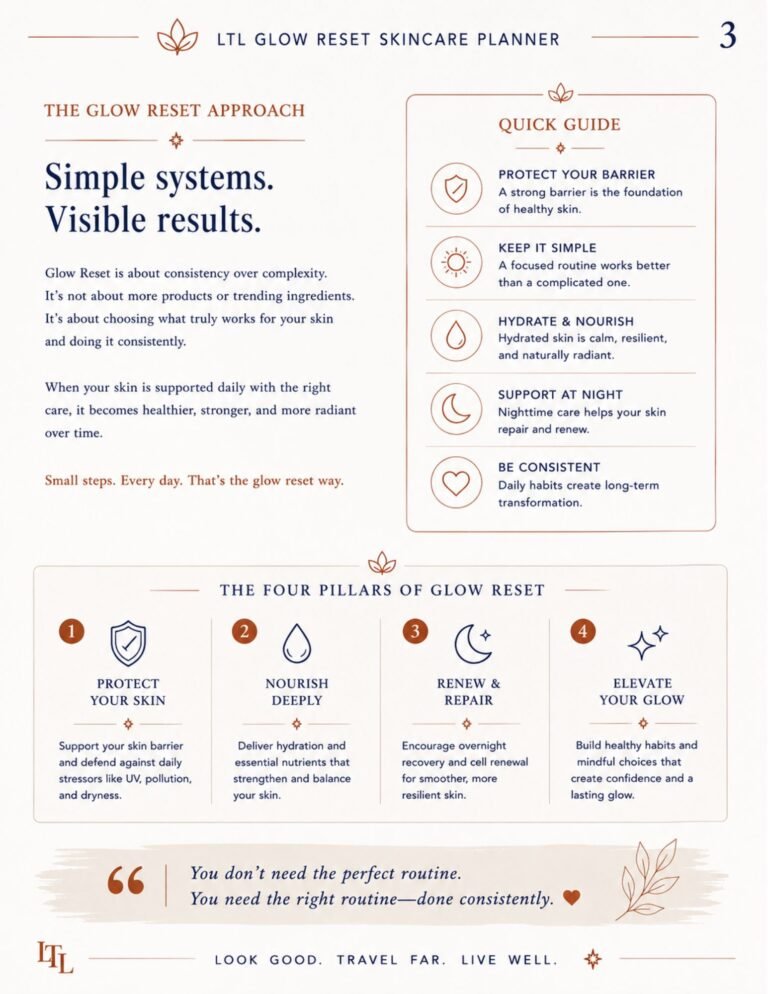

ix. Glow Reset Planner
One thing dark spots taught me is how easy it is to make skincare more complicated than it needs to be.
When progress feels slow, we start adding things. Another serum, another active ingredient, another step that promises to work faster. Before long, it becomes difficult to tell what’s helping, what’s causing irritation, or whether we’ve given anything enough time to work.
That’s one of the reasons we created the Glow Reset Planner.
The planner provides a practical framework for taking a closer look at your skincare routine, supporting hydration and the skin barrier, and building daily habits that are easier to maintain. For stubborn pigmentation especially, that consistency can matter more than continually changing products.
Inside, you’ll find guidance and planning pages focused on daily skincare, hydration, skin-barrier support, recovery, product routines, healthy lifestyle habits, and creating greater consistency without making skincare unnecessarily complicated.
👉 Get your complimentary “Glow Reset Planner” 4-Page Sampler. Click here to download.
A selected preview from the complete planner to help you simplify your routine, track what you’re actually doing, and give your skin enough consistency to see what may be working.
🛍 If you’d like to continue, the complete Glow Reset Planner is a 24-page premium LTL Living Guide designed to help you build a more thoughtful skincare routine, support healthier daily habits, and stop feeling as though you need to start over every time your skin changes.
Sometimes a reset isn’t about doing more. It’s about figuring out what your skin actually needs.
XII. DARK SPOTS. GLOW RESET. | Final Thoughts
Dark spots can test our patience because progress rarely happens as quickly as we’d like.
When dark spots won’t fade, the natural reaction is to search for something stronger. Another serum. Another acid. Another ingredient promising brighter skin. But after everything we’ve discussed, I think the better approach is often more measured.
First, understand what you’re treating. Protect your skin from the sun every day. Reduce the inflammation that can create new marks. Avoid pushing the skin so hard that irritation becomes another problem. Then choose a routine you can follow consistently enough to give it a real chance.
Some pigmentation will improve gradually. Some may need professional treatment. And some spots should be evaluated by a dermatologist rather than treated cosmetically at home.
Most importantly, don’t judge your skin by what you see from one morning to the next. Pigmentation develops over time, and improvement often happens the same way.
Take care of the skin around the spot while you’re trying to fade the spot itself.
That, to me, is what a good reset should do.
DARK SPOTS. GLOW RESET.
With care,
Mijung