
10 Korean Skincare Dupes for Luxury Skincare | Glow Reset
Look Good. Travel Far. Live Well ◆ Skincare & Beauty by Mijung | K- Beauty & Flight Attendant Experience
I. introduction: Korean Skincare Dupes
Korean skincare dupes have become popular for a simple reason: some very good skincare doesn’t have to come with a luxury price tag.
I love beautiful skincare. I always have.
During my years as a Korean Air flight attendant, skincare was practically part of the conversation. We spent long hours in incredibly dry airplane cabins, traveled between different climates, and were expected to step off the aircraft looking polished no matter how tired our skin felt.
When you work alongside other women who care about skincare, you talk about products—a lot.
Which serum are you using? Did that cream actually help? Is the expensive one really better? What did you buy in Seoul this time?
Years later, when I had the opportunity to work around Korean cosmetic R&D, those conversations started to look different to me. I became much more interested in ingredients, formulations, texture, and what a product was actually designed to accomplish.
That’s also why I’m careful with the word dupe.
A good dupe isn’t simply a cheaper product that someone on social media says is “just like” an expensive one. The formulas may be quite different. What matters is understanding why we wanted the luxury product in the first place and whether another well-formulated product can address that same skincare concern.
Sometimes it can.
Sometimes it can’t.
I still use luxury skincare when I think it’s worth it. But I’ve also seen enough excellent Korean formulations to know that a beautiful jar and a beautiful price don’t automatically mean better skincare.
This isn’t about choosing luxury or choosing inexpensive.
It’s about understanding what we’re paying for—and what our skin actually needs.
Quick Guide
In this guide, we’ll look at:
- What actually makes a skincare product a useful dupe
- Why Korean skincare can offer such compelling alternatives
- 10 luxury skincare products and the Korean alternatives worth considering
- How hydration and barrier-support products compare
- Korean alternatives for serums, ferments, peptides, and firming
- Options for brightening, dark spots, texture, and exfoliation
- Where the luxury and Korean formulas are genuinely different
- When I would choose the Korean alternative—and when I wouldn’t
- Our updated Mijung’s K-Beauty Picks
- The Glow Reset Planner for building a routine around what your own skin actually needs
This Guide Is For…
This guide is for women who love good skincare but have started wondering whether every expensive product in the bathroom really needs to be expensive.
Maybe you’ve used a luxury serum or cream for years and love it, but you’re curious about Korean alternatives. Perhaps you’ve discovered K-beauty and aren’t sure which products are genuinely worth trying. Or maybe you’re simply tired of being told that every inexpensive product is a “dupe” for something costing five times as much.
It’s also for women whose skin is changing. Dryness may be more noticeable. The skin barrier may not recover as quickly. Uneven tone, texture, firmness, and sensitivity may matter more than they did years ago.
I don’t think we need to choose sides between luxury skincare and Korean skincare.
Instead, we’ll look at what each product is designed to do, where the formulas overlap, where they don’t, and whether the less expensive option makes sense for the skin concern we’re trying to address.
That’s a much better way to think about Korean skincare dupes than simply comparing price tags.
Good skincare isn’t about paying the most. It’s about understanding what your skin needs—and choosing well.
II. What Makes Korean Skincare Dupes Worth Considering?
The word dupe gets used very loosely in skincare.
Sometimes two products have similar packaging. Sometimes they share one popular ingredient. Sometimes a less expensive product becomes famous online simply because someone says, “This is just like the $200 one.”
That’s not enough for me.
When I compare Korean skincare dupes with luxury products, I start with a different question: What are we asking this product to do for our skin?
If we’re buying an expensive cream because our skin feels dry and uncomfortable, I want to know how it moisturizes and supports the skin barrier. If it’s a serum for uneven tone, I’m interested in the ingredients being used for brightening. If we’re paying for peptides, ferments, exfoliating acids, or soothing ingredients, those are the things worth comparing.
That doesn’t mean the formulas have to be identical. In fact, they usually aren’t.
Texture can be different. Ingredient concentrations may differ. One formula may contain patented ingredients or proprietary complexes that simply don’t exist in the alternative. Even the experience of using a luxury product—the fragrance, packaging, texture, and finish—can be part of what we’re paying for.
There’s nothing wrong with enjoying that.
The question is whether we need to pay for it every time.
For this guide, I’m using dupe to mean a thoughtful alternative for a similar skincare goal, not an identical formula promising identical results. That’s a more useful comparison—and a much more honest one.
⭐ Recommended Reading
III. Why I Look to Korean Skincare First
Korean skincare was part of my life long before K-beauty became an international trend.
During my years as a Korean Air flight attendant, we were constantly dealing with dry cabin air, changing climates, long working days, makeup, and disrupted sleep. Skincare wasn’t something we discussed occasionally. It was an ongoing conversation among the women I worked with.
Someone was always trying a new essence, cream, mask, or treatment. We’d compare what felt good after a long flight, what made makeup sit better, what irritated our skin, and which expensive purchase wasn’t worth buying again.
Later, my perspective changed again when I became involved with Korean cosmetic R&D. I started seeing skincare less as a collection of beautiful products and more as formulations built around specific ingredients and skin concerns.
That experience is one reason I still look toward Korea when I’m searching for alternatives.
K-beauty has become famous for essences, ampoules, lightweight hydration, soothing ingredients, barrier care, ferments, masks, and increasingly sophisticated treatment products. But I don’t believe something deserves a recommendation simply because it’s Korean.
There are wonderful Korean products and ordinary Korean products, just as there are wonderful and ordinary luxury products.
What interests me is finding the ones that make me think: This is very well formulated for what I’m trying to accomplish. Why would I automatically spend more?
That’s where this comparison becomes useful.
IV. Korean Skincare Dupes | Hydration & Barrier Care
Hydration is one of the first places I look when comparing luxury skincare with Korean alternatives.
As skin becomes drier or more sensitive, it can be tempting to assume that a richer—and usually more expensive—cream must be the answer. But price alone tells us very little about whether a product will actually suit our skin.
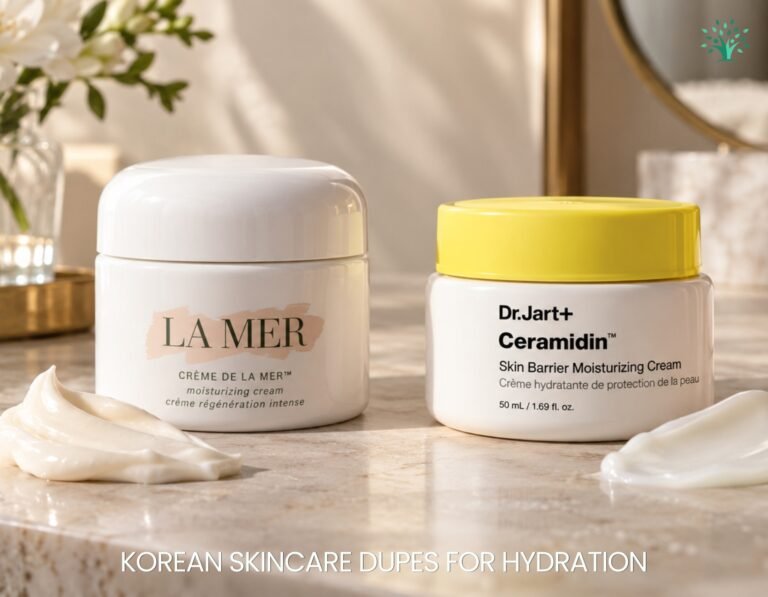
La Mer Crème de la Mer → Dr. Jart+ Ceramidin Skin Barrier Cream
La Mer’s Crème de la Mer is one of the most recognizable luxury moisturizers in the world. People aren’t buying it simply for moisture; they’re buying the entire La Mer experience, including its signature formulation, rich texture, heritage, and luxury positioning.
So I wouldn’t tell someone that Dr. Jart+ Ceramidin Cream is “La Mer for less.” It isn’t.
What makes Dr. Jart+ Ceramidin Skin Barrier Cream interesting is that it answers one of the main reasons many women reach for a rich luxury moisturizer in the first place: dry, uncomfortable skin that needs stronger barrier support and lasting moisture.
Ceramide-focused skincare makes particular sense when the skin feels dry, tight, or easily irritated. Instead of trying to imitate La Mer, Ceramidin takes a more straightforward barrier-care approach.
For me, that’s a useful alternative—not because the two jars contain the same thing, but because I would ask myself what I’m actually trying to solve before spending luxury-cream money.
LTL Pick: Dr. Jart+ Ceramidin Skin Barrier Cream
Dr. Barbara Sturm Hyaluronic Serum → Torriden DIVE-IN Toner
This comparison illustrates why I don’t require a dupe to be the same type of product.
Dr. Barbara Sturm’s Hyaluronic Serum is positioned as a premium hydration serum. Torriden DIVE-IN Toner is a toner, so these clearly aren’t formula-for-formula substitutes.
But if the reason I’m shopping is that my skin needs lightweight, layerable hydration, Torriden becomes much more interesting.
I like this kind of product because hydration doesn’t always have to come from one expensive serum. A hydrating toner can become an easy first layer after cleansing, followed by an essence, ampoule, or moisturizer depending on what the skin needs that day.
That’s very much the Korean skincare approach I grew up around: rather than expecting one expensive bottle to do everything, build comfortable layers without overwhelming the skin.
LTL Pick: Torriden DIVE-IN Toner
These are the kinds of Korean skincare dupes I find most useful—not copies, but intelligently chosen alternatives that make us reconsider what we’re really paying for.
V. Luxury Serum & Ferment Dupes
Serums and essences are where Korean skincare gets especially interesting. Instead of trying to make one product do everything, many K-beauty formulas focus on hydration, barrier support, texture, or fermented ingredients that can be layered into a routine.
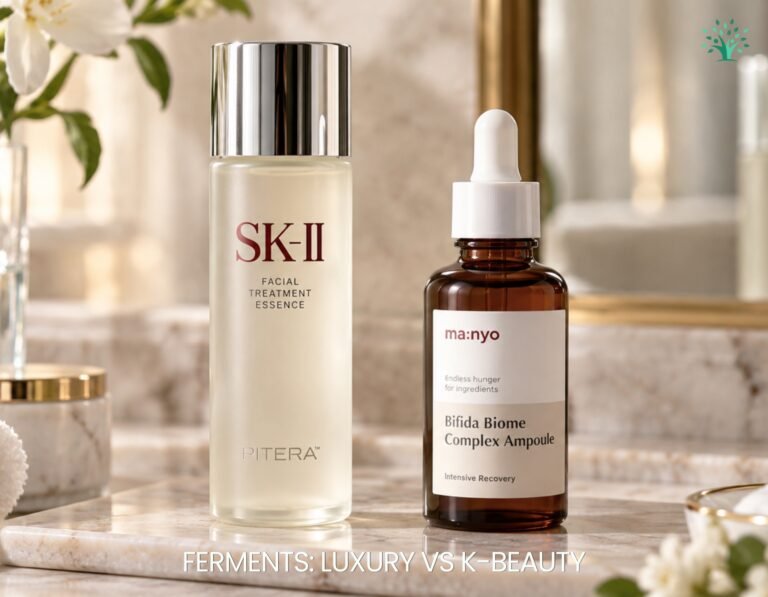
SK-II Facial Treatment Essence → Ma:nyo Bifida Biome Ampoule
SK-II Facial Treatment Essence is famous for its PITERA™ ferment filtrate and has earned a loyal following over decades. Ma:nyo Bifida Biome Ampoule isn’t a copy of SK-II and uses a different ferment approach.
What they share is the broader idea of using fermented skincare ingredients to support healthier-looking, more resilient skin.
For someone interested in adding a ferment-focused product without paying SK-II prices, Ma:nyo is an alternative I think is worth considering.
LTL Pick: Ma:nyo Bifida Biome Ampoule
Estée Lauder Advanced Night Repair → Mixsoon Bean Essence
Estée Lauder Advanced Night Repair is another product I wouldn’t pretend has an identical inexpensive replacement. It’s a sophisticated proprietary formula with a very different ingredient profile.
Mixsoon Bean Essence interests me for a simpler reason: it gives us a lightweight Korean essence focused on fermented ingredients, hydration, and improving the feel and appearance of skin texture.
Different formulas. Different experiences. But they can occupy a similar decision in my routine: do I want an expensive multitasking serum, or would a simpler hydrating ferment product give my skin what I’m actually looking for?
LTL Pick: Mixsoon Bean Essence
⭐ Recommended Reading
VI. Korean Skincare Dupes | Peptides & Firming
Once firmness and fine lines become concerns, it’s easy to find ourselves staring at increasingly expensive jars.
This is one area where I pay more attention to the formulation than the prestige attached to it.
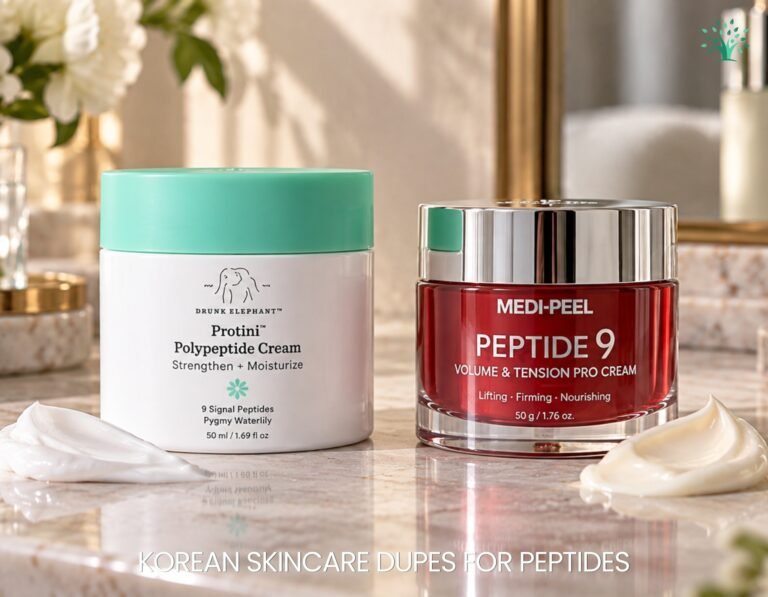
Drunk Elephant Protini Polypeptide Cream → Medi-Peel Peptide 9 Volume Bio Tox Cream
Drunk Elephant Protini Polypeptide Cream helped make peptide moisturizers mainstream. Its appeal is understandable: peptides, hydration, and a moisturizer all in one step.
Medi-Peel Peptide 9 Volume Bio Tox Cream gives us a Korean peptide-focused option aimed at hydration, elasticity, and firmer-looking skin.
Again, these aren’t identical formulas. That’s not the point.
If peptides are the reason you’re considering a premium firming moisturizer, Medi-Peel gives you another route to explore before automatically reaching for the more expensive jar.
LTL Pick: Medi-Peel Peptide 9 Volume Bio Tox Cream
For mature skin, I particularly like products that can address more than one everyday concern without making the routine unnecessarily complicated. Hydration plus a peptide-focused treatment fits that philosophy well.
VII. Brightening, Texture & Exfoliation Dupes
This is where I become more cautious with the word dupe. Vitamin C, exfoliating acids, and pigmentation treatments can vary considerably in strength, formulation, stability, and tolerability.
Similar purpose does not automatically mean interchangeable.
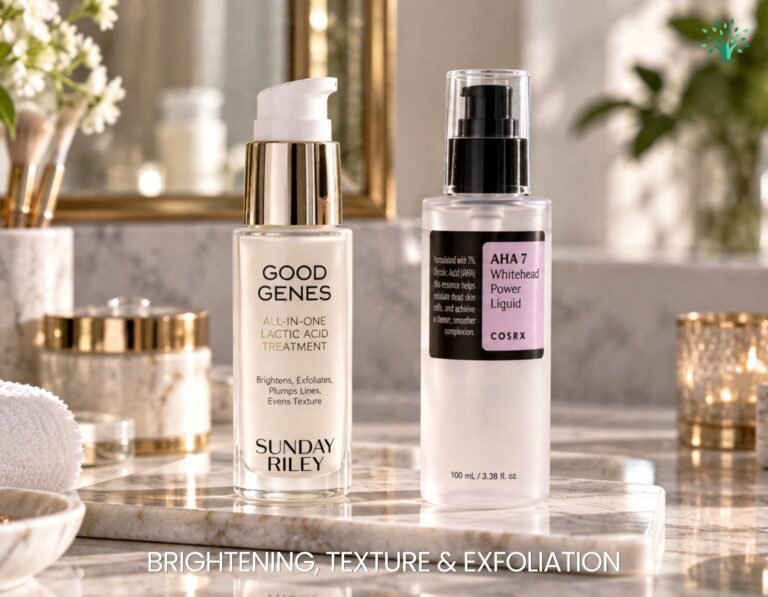
Sunday Riley Good Genes → COSRX AHA 7 Whitehead Power Liquid
Sunday Riley Good Genes and COSRX AHA 7 Whitehead Power Liquid both bring exfoliation into the conversation, but they’re not the same treatment.
COSRX uses glycolic acid to help exfoliate dead surface cells and improve the appearance of texture and congestion. It’s a much more straightforward approach—and one that should still be introduced carefully rather than treated as an everyday “more is better” product.
LTL Pick: COSRX AHA 7 Whitehead Power Liquid
This is also where price should never be the only reason we switch products. With exfoliants and stronger active ingredients, I care much more about what the ingredient is, how my skin tolerates it, and whether it belongs in my routine at all.
A less expensive active that irritates your skin isn’t a bargain.
VIII. When I Wouldn't Buy the Dupe
There are times when I wouldn’t switch.
If a luxury product works beautifully for my skin, fits comfortably into my budget, and I genuinely enjoy using it, I don’t see a reason to replace it simply because something cheaper exists.
I also wouldn’t substitute products just because they share one fashionable ingredient. Vitamin C isn’t automatically equivalent to another vitamin C formula. The same is true for acids, retinoids, peptides, and many other active ingredients.
Formulation matters.
And if we’re dealing with a specific skin problem rather than everyday cosmetic concerns, that’s different from shopping for a moisturizer or essence. Sometimes professional guidance is more useful than buying another bottle.
The point of Korean skincare dupes isn’t to prove that expensive skincare is a waste of money.
It’s to give ourselves another choice.
Sometimes I’ll happily buy the Korean alternative. Sometimes I’ll spend more. What matters is knowing why I’m choosing one over the other.
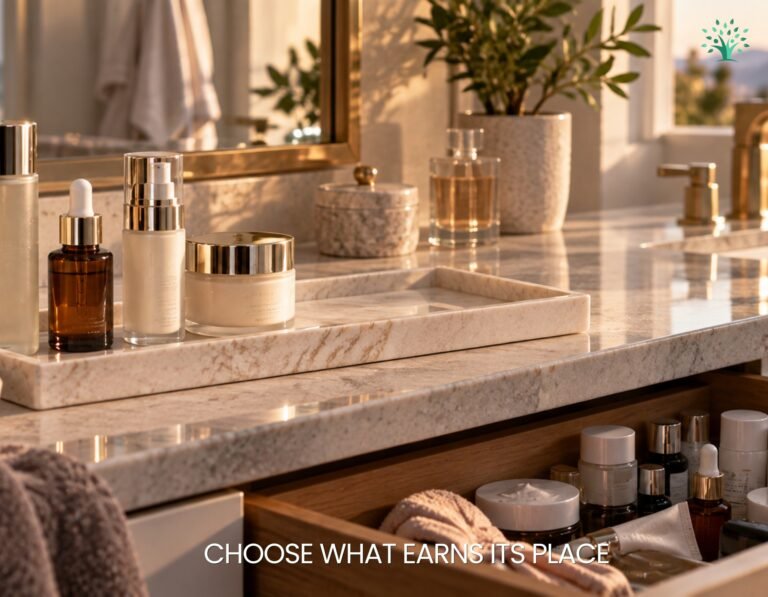
IX. How I Shop for Korean Skincare Now
I shop differently today than I did when I was younger.
I used to get excited about discovering the newest product. Now I’m much more interested in whether something has a clear reason to be in my routine.
I start with the skin concern.
Do I need more hydration? Is my skin barrier feeling uncomfortable? Am I trying to improve uneven tone or texture? Do I actually need another active ingredient—or would my skin be happier if I simply left it alone for a few days?
Then I look at the formulation, texture, how it fits with everything else I’m already using, and whether I’m likely to use it consistently.
This approach has made my skincare routine simpler.
K-beauty still gives us an enormous number of choices, and I enjoy discovering new products. But new doesn’t automatically mean necessary.
I’d rather have six products I understand and actually use than twenty bottles competing for space on my bathroom counter.
Buy for your skin, not for the shelf.
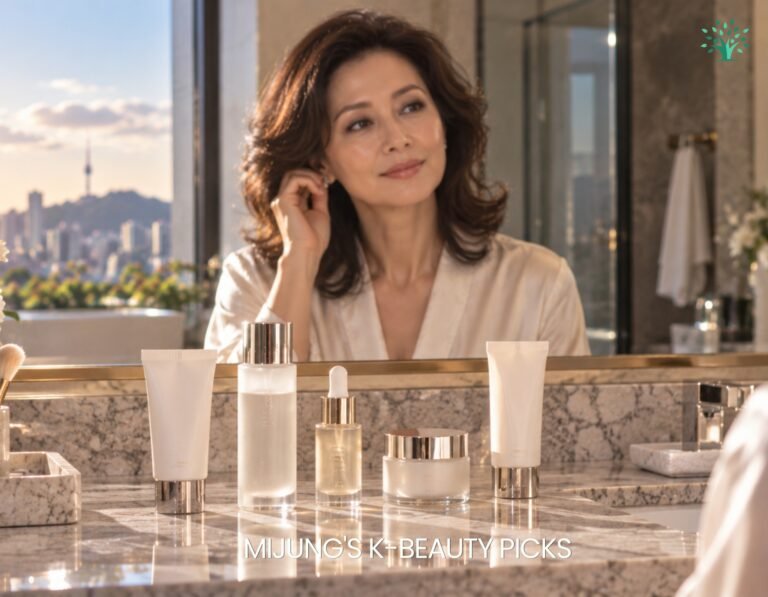
X. Mijung's K-Beauty Picks
One thing I’ve learned about skincare is that more choices don’t necessarily make choosing easier.
K-beauty has grown enormously, and there always seems to be another serum, ampoule, cream, or ingredient everyone is suddenly talking about. Some are excellent. Others simply aren’t necessary.
So I’ve put together Look Good – Mijung’s K-Beauty Picks differently.
It’s a small, curated collection of Korean skincare we’ve recommended over the years, along with a few newer discoveries I think are worth knowing about. You’ll find options for hydration, barrier support, soothing, brightening, firmness, exfoliation, and daily sun protection—but not dozens of nearly identical products competing for your attention.
Think of it as the shelf I would rather show a friend than an endless beauty aisle.
You don’t need everything on it.
Start with what your skin needs, choose thoughtfully, and build from there.
EXPLORE MIJUNG’S K-BEAUTY PICKS →
That feels much more LTL: clean, personal, curated, and premium. The actual 16 products live beautifully in the Shop collection instead of being dumped into the editorial.
Explore More in the LTL Shop
Looking for more of the skincare and beauty products we use and recommend? Visit the LTL Shop for our curated collection of skincare, Korean beauty, Age Well, and everyday beauty essentials.
XI. Glow Reset Planner
One thing dark spots taught me is how easy it is to make skincare more complicated than it needs to be.
When progress feels slow, we start adding things. Another serum, another active ingredient, another step that promises to work faster. Before long, it becomes difficult to tell what’s helping, what’s causing irritation, or whether we’ve given anything enough time to work.
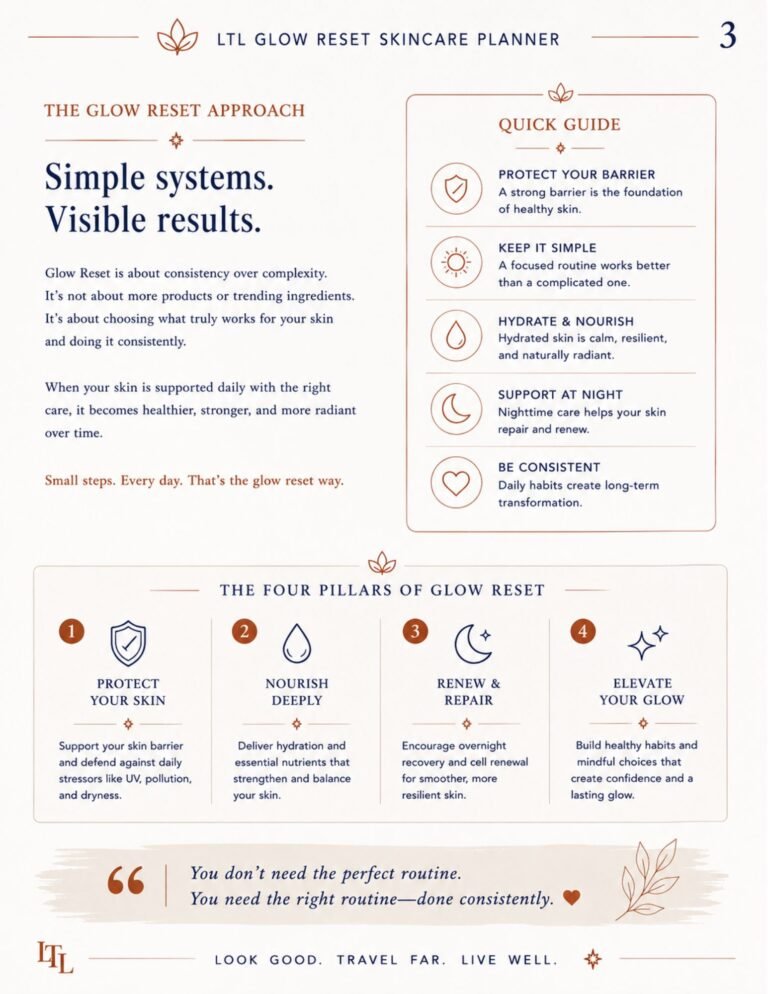
That’s one of the reasons we created the Glow Reset Planner.
The planner provides a practical framework for taking a closer look at your skincare routine, supporting hydration and the skin barrier, and building daily habits that are easier to maintain. For stubborn pigmentation especially, that consistency can matter more than continually changing products.
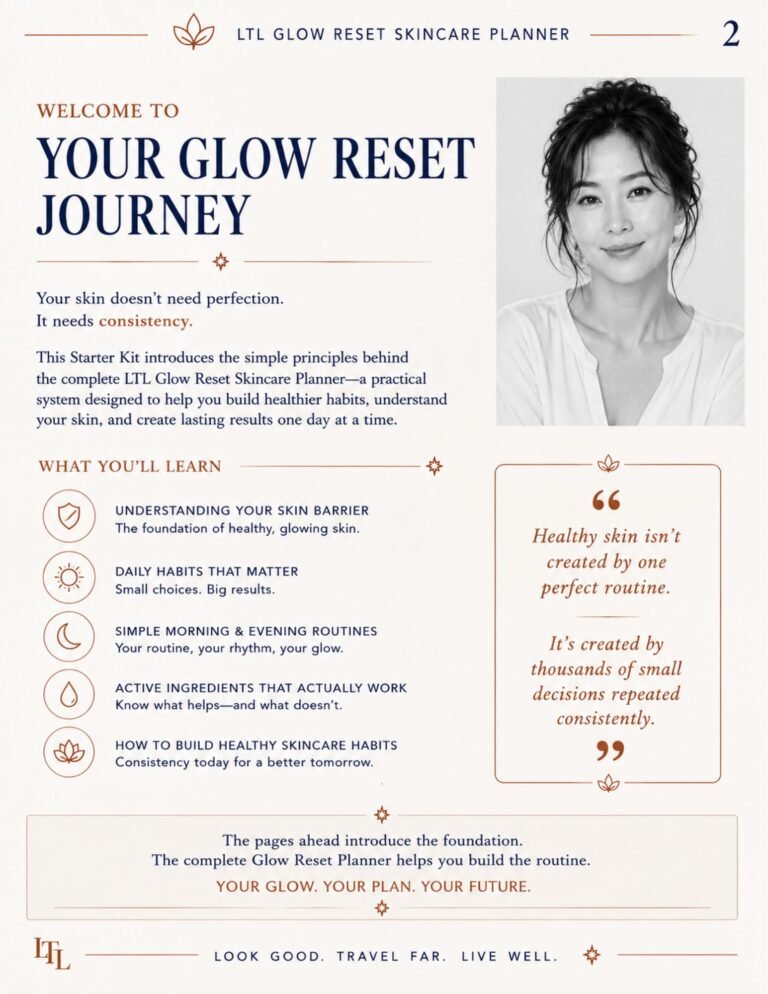
Inside, you’ll find guidance and planning pages focused on daily skincare, hydration, skin-barrier support, recovery, product routines, healthy lifestyle habits, and creating greater consistency without making skincare unnecessarily complicated.
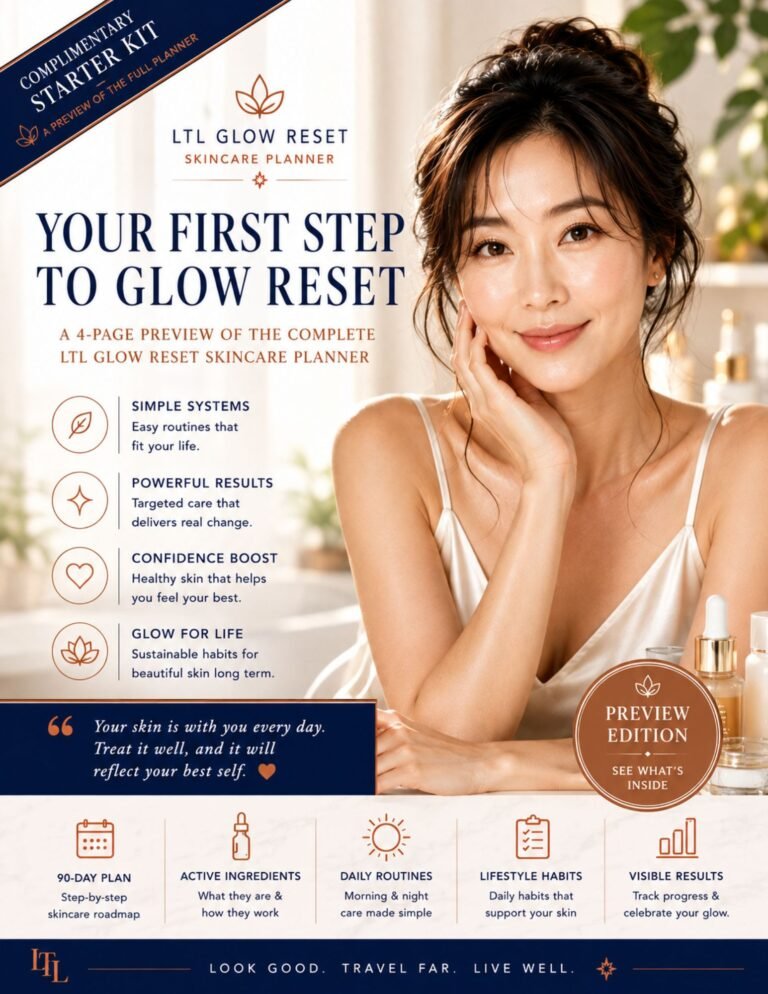
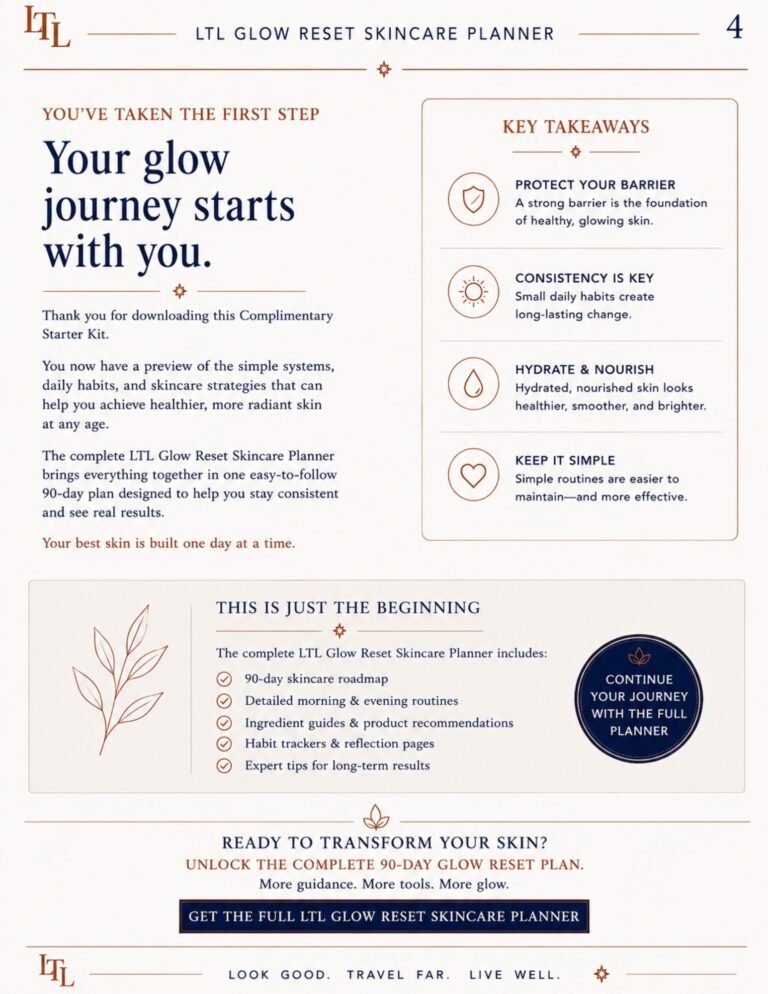
👉 Get your complimentary “Glow Reset Planner” 4-Page Sampler. Click here to download.
A selected preview from the complete planner to help you simplify your routine, track what you’re actually doing, and give your skin enough consistency to see what may be working.
🛍 If you’d like to continue, the complete Glow Reset Planner is a 24-page premium LTL Living Guide designed to help you build a more thoughtful skincare routine, support healthier daily habits, and stop feeling as though you need to start over every time your skin changes.
Sometimes a reset isn’t about doing more. It’s about figuring out what your skin actually needs.
XII. Smart Skincare | Final Thoughts
I’ve spent enough years around skincare to know how easy it is to believe that the next product might be the one.
The expensive serum. The cream everyone is talking about. The newest ingredient coming out of Korea. I’ve been curious about all of them too.
But the older I get, the less interested I am in collecting products and the more interested I am in understanding my skin.
That’s really the point of these Korean skincare dupes.
They aren’t proof that luxury skincare is overpriced, and they aren’t promises that a $30 product will perform exactly like one costing $200. They’re simply reminders that we have more choices than ever—and price doesn’t always tell us which choice is right for our skin.
Keep the luxury product you genuinely love.
Replace the expensive one that never quite justified its price.
Try the Korean alternative when the formulation and purpose make sense for you. And don’t be afraid to use fewer products when that’s what your skin is asking for.
After all these years of talking about skincare with other women, that’s probably the advice I believe most.
Know your skin. Know what you’re buying. And spend where it matters to you.
Because looking good was never supposed to mean buying everything.
SMART SKINCARE. GLOW RESET.
With care,
Mijung