
Why Travel Exhaustion Builds in Winter
LifeStyle Wellness on the Go by Samuel
I. INTRODUCTION — Why Travel Exhaustion Builds in Winter
There’s a point in winter when travel stops feeling straightforward. Each trip looks manageable on paper. Flights are shorter. Schedules aren’t extreme. Yet after a few trips, something changes. Energy doesn’t rebound the way it used to. Sleep feels lighter. Focus takes longer to come back. This is when Travel Exhaustion Builds, even though no single trip felt overwhelming.
What makes winter travel exhaustion tricky is that it’s rarely immediate. You land. You unpack. You’re technically home. A day or two later, the fatigue shows up. Motivation dips. Recovery drags. Small decisions feel heavier than they should. It doesn’t register as burnout. It feels cumulative.
I’ve experienced this pattern across years of frequent travel. The exhaustion rarely hit mid-flight or at the gate. It showed up afterward, once the nervous system finally slowed down enough to register the cost. Winter amplifies that effect because the body is already operating with less margin. Cold exposure, reduced daylight, disrupted sleep, and constant schedule shifts quietly stack up.
This isn’t about one bad trip or poor planning. It’s about repeated disruption layered on top of a season that already demands more from the body. When you understand why travel exhaustion builds in winter, you stop expecting quick rebounds and start focusing on recovery strategies that actually restore capacity between trips.
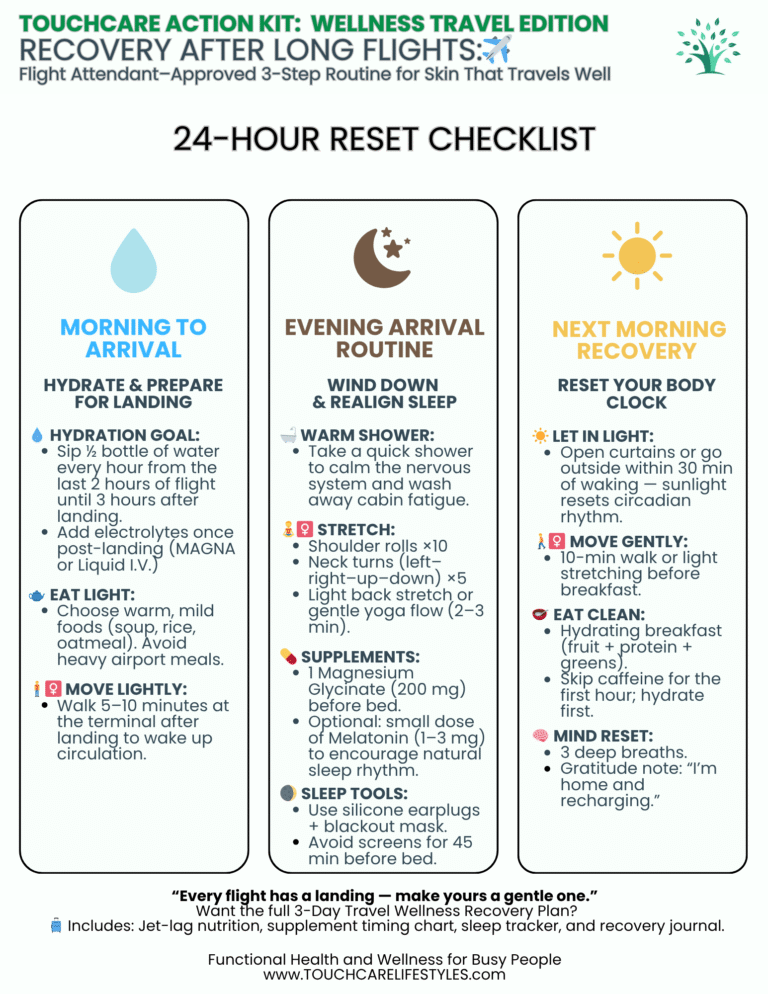
📥 BONUS: Download the 1-page printable infographic at the end of this post! Stick it to your mirror and carry them. Your full 24-Hour Reset Checklist.
Quick Jump Guide
• Why travel exhaustion often feels delayed instead of immediate
• How repeated trips quietly drain recovery capacity in winter
• The nervous system’s role in post-travel fatigue
• Why winter makes travel harder to bounce back from
• What helps restore energy between trips, not after burnout
This Guide Is for You If…
• You feel fine traveling but crash days later
• Winter trips take longer to recover from than summer ones
• Sleep doesn’t fully reset you after flights
• Short trips leave you unexpectedly drained
• You want to recover between trips instead of pushing through fatigue

II. Why Travel Exhaustion Feels Delayed Instead of Immediate
Travel exhaustion in winter rarely hits all at once. During the trip itself, the body often stays in execution mode. Adrenaline carries you through airports, meetings, family obligations, or tight schedules. Even when sleep is short, the nervous system stays alert enough to function.
The cost shows up later. Once travel ends and external demands drop, the body finally has space to register disruption. That’s when fatigue surfaces. Energy dips. Sleep feels fragmented. Motivation drops without a clear reason. This delay makes travel exhaustion easy to underestimate.
Winter intensifies this pattern. Short daylight hours compress circadian rhythm. Cold exposure increases baseline stress. Recovery signals become weaker. Instead of bouncing back quickly, the body takes longer to recalibrate after each trip.
Delayed exhaustion isn’t a failure of resilience. It’s a sign that recovery is being postponed until the system feels safe enough to slow down.
Recommended Reading:
III. How Winter Travel Quietly Drains the Nervous System
Every trip asks the nervous system to stay alert. Airports are stimulating environments. Schedules shift. Meals become irregular. Sleep timing changes. Even short trips require constant adjustment.
In winter, the nervous system starts from a more strained baseline. Reduced daylight affects hormone signaling. Cold temperatures keep the body in a slightly activated state. Movement often drops outside of travel itself. Together, these factors lower recovery capacity before the trip even begins.
Because the drain is subtle, it often goes unnoticed. You may feel functional while traveling but less resilient afterward. Focus becomes harder to sustain. Emotional tolerance shrinks. Small stressors feel heavier than usual.
This isn’t psychological. It’s physiological. Repeated activation without sufficient downshifting trains the nervous system to stay on longer than it should.
Recommended Reading:
IV. Why Repeated Trips Make Travel Exhaustion Build Faster in Winter
One trip rarely causes a problem. The issue comes from accumulation. Each journey pulls from the same recovery reserve. When winter limits how quickly that reserve refills, exhaustion compounds.
Shorter trips can be especially deceptive. Because disruption feels minimal, recovery often gets skipped. Sleep debt carries over. Hydration stays low. Routine never fully resets. Over time, the gap between demand and recovery widens.
At this stage, pushing through stops working. The body isn’t signaling laziness. It’s signaling reduced capacity. Without intentional recovery between trips, exhaustion continues to build beneath the surface.
Understanding this shift is key. Travel exhaustion in winter isn’t about toughness. It’s about respecting how seasonal conditions change the cost of movement.
Recommended Reading:

V. How Travel Exhaustion Builds in the Body, Not Just the Schedule
Travel exhaustion doesn’t live on your calendar. It builds inside the body. Disrupted sleep, irregular meals, dehydration, and constant alertness accumulate beneath the surface, especially in winter when recovery capacity is already lower.
Hydration is one of the first systems to fall behind. Cold air, dry cabins, and reduced thirst cues quietly pull fluid out of balance. Electrolytes Powder – Liquid IV helps restore hydration more efficiently than water alone, which matters when repeated trips don’t leave time for a full reset.
Stress chemistry also shifts with frequent travel. The nervous system stays “on” longer than it should, even after you return home. L-Theanine – Horbäach supports calm focus, helping the system downshift without sedation when post-travel tension lingers.
Immune vigilance adds another layer. Winter travel exposes the body to constant environmental change. Echinacea & Goldenseal – Horbäach supports immune resilience, reducing the background alertness that quietly drains energy between trips.
Recommended Reading:
External: CDC – Jet Lag & Sleep Tips for Travelers
VI. What Actually Helps When Travel Exhaustion Builds
When exhaustion becomes cumulative, recovery has to be intentional. That doesn’t mean doing more. It means supporting the systems that have been carrying extra load for weeks or months.
Physical tension and shallow sleep often go unnoticed until energy drops. Magnesium Glycinate – Nature’s Bounty supports muscle relaxation and nervous system signaling, creating better conditions for deeper rest after travel.
Adaptation matters as well. Repeated disruption asks the body to respond flexibly, not forcefully. Rhodiola – Horbäach supports stress adaptation, helping the system respond to ongoing demand without staying locked in depletion mode.
Inflammatory load builds quietly with frequent movement and poor recovery. Omega-3 Fish Oil – Nordic Naturals supports inflammatory balance, which can improve how the body responds to rest, movement, and sleep between trips.
Digestion and circulation also influence recovery more than most travelers realize. Organic Ginger Tea gently supports warmth, digestion, and blood flow, helping nutrients reach tissues that need repair after travel.
Exhaustion eases when the whole system feels supported, not pushed.
Recommended Reading:

VII. Products That Support Recovery from Travel Exhaustion
When travel exhaustion builds in winter, the goal isn’t stimulation. It’s restoration. These are the products I rely on because they support recovery without forcing energy.
Echinacea & Goldenseal – Horbäach
Supports immune resilience during frequent travel, reducing background vigilance.
Electrolytes Powder – Liquid IV
Improves hydration efficiency after flights and dry environments.
Magnesium Glycinate – Nature’s Bounty
Supports relaxation and sleep quality, essential for nervous system recovery.
Omega-3 Fish Oil – Nordic Naturals
Helps balance inflammation and supports cellular recovery.
L-Theanine – Horbäach
Promotes calm focus, helping the nervous system downshift post-travel.
Rhodiola – Horbäach
Supports stress adaptation during repeated disruption.
Organic Ginger Tea
Supports digestion, circulation, and warmth after travel.
To make your choices easier, I’ve included the products I personally rely on during long flights and layovers. As an Amazon Associate, I earn from qualifying purchases. These are the same tools I trust in my own travel-wellness routine and recommend because they truly work.
VIII. After-Travel Reset — Travel Wellness Recovery Kit
When travel exhaustion builds, recovery needs structure. Not discipline. Structure.
The Travel Wellness Recovery Kit (After Travel) was created to guide the days immediately following a trip. It focuses on hydration cues, nervous system settling, gentle movement, and sleep support—so recovery starts before exhaustion compounds.
The body doesn’t respond to intention alone. It responds to repeated signals of safety and consistency. This reset helps restore those signals between trips.
📥 BONUS: Download Free 1-Page 24-Hour Reset Checklist
This simple PDF puts my Travel 24-Hour Reset Checklist into one page you can actually use.
IX. Final Thoughts — Travel Exhaustion Is a Signal, Not a Flaw
If travel feels harder in winter, it’s not because you’ve become less resilient. The body is paying a higher price for every disruption. Cold exposure, low daylight, broken sleep, dehydration, and constant alertness stack quietly over time. Nothing suddenly breaks. Capacity just gets thinner.
Waiting for a crash before taking recovery seriously is the most common mistake frequent travelers make. Fatigue gets normalized. The assumption becomes that it’s temporary. Rest gets postponed. By the time recovery finally happens, exhaustion has already compounded.
This isn’t a personal failure. At its core, it’s a systems issue. When recovery doesn’t keep pace with demand, the body sends signals—lower energy, lighter sleep, slower rebound. Ignoring those signals doesn’t build toughness. Left unaddressed, it builds debt instead.
Winter changes the math. What felt manageable in other seasons now costs more. Respecting that shift isn’t weakness. It’s how long-term capacity, clarity, and health are protected—especially when travel is part of life, not an exception.
Don’t wait to recover after burnout.
Recover early.
Do it deliberately.
Travel Exhaustion Is a Signal, Not a Flaw
With care,
Samuel
⭐ Upgrade Your Wellness Routine
If this guide helped you feel more prepared for long flights, you may appreciate the premium Travel Recovery Planner I designed to go with it.
It’s a clean, structured 17-page TouchCare Action Kit that walks you through everything from landing to the next morning — hydration plan, digestion reset, circulation routine, anti-bloat support, light meals, sleep cues, and a full 24-hour recovery flow.
If you want a simple, printable version of the routine I personally use after every long haul, you can find the premium edition on Gumroad.
✨ GoWithGuide – My Trusted Travel Shortcut
When I want to Travel Far Live Well, time is my most valuable resource. I’ve used GoWithGuide in Tokyo, Seoul, Shenzhen, and even Rome, and the difference was clear: less stress, more local culture, and the freedom to focus on wellness instead of logistics.
Whether you’re on a tight schedule, traveling solo, or just want to dive deeper into authentic neighborhoods, a private guide helps you maximize every hour. It’s one of the simplest ways to balance exploration with recovery so you leave with energy—not exhaustion.