

Sleep Reset: Why You Wake Up Tired
◆ Functional Health & Wellness by Samuel
I. INTRODUCTION — Why a Sleep Reset Matters More Than 7 Hours
A Sleep Reset became necessary for me when I realized that seven hours in bed did not mean seven hours of recovery. I was technically sleeping long enough. The tracker showed decent numbers. Yet mornings felt heavy, foggy, and slightly behind.
That gap between time asleep and feeling restored is where most people get confused. Duration is easy to measure. Quality is harder to see. You can accumulate hours and still miss deep recovery if stress hormones remain elevated, inflammation lingers, or your nervous system never fully powers down.
Late-night stimulation plays a bigger role than we admit. Work thoughts carry into bed. Screens extend daylight artificially. Cortisol, which should taper in the evening, stays active longer than intended. When that happens, deep sleep shortens even if total sleep time looks acceptable.
Morning fatigue is rarely about laziness. It reflects incomplete recovery. Muscles remain tense. Brain waves never fully drop into restorative depth. Fluid retention increases slightly. Inflammation does not clear overnight. The result is waking up technically rested but physiologically unfinished.
Most people respond by adding caffeine. Others attempt to sleep longer. Neither addresses the underlying rhythm. A disciplined reset works differently. Instead of chasing more hours, it restores alignment — stress control, hydration timing, inflammation reduction, and a structured wind-down that allows the nervous system to shift properly.
I can tell you sleep is not just quantity. Recovery is the goal.
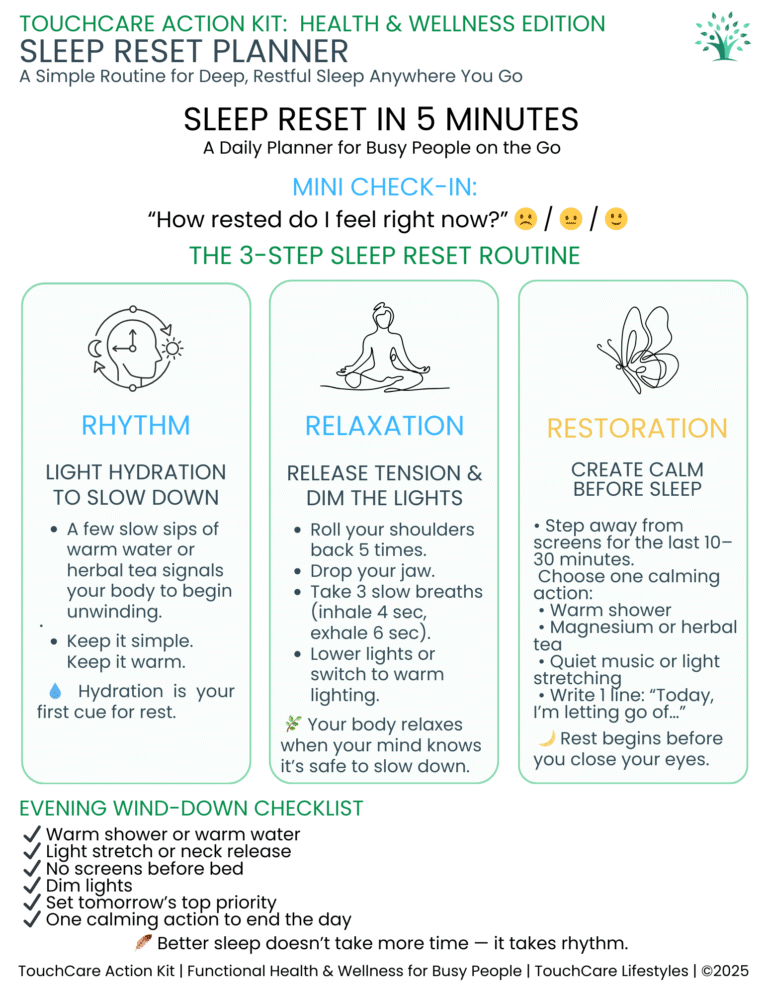
📥 BONUS: Download the FREE 1-page printable infographic PDF at the end of this post! Stick it to your mirror and carry them. Your SLEEP RESET IN 5 MINUTES.
Quick Jump Guide
• Why seven hours can still leave you tired
• How cortisol disrupts deep sleep
• What “tired but wired” actually means
• The link between inflammation and heavy mornings
• Why hydration timing affects overnight recovery
• How a structured Sleep Reset improves sleep depth
This Guide Is for You If…
• You sleep 6–8 hours but wake up foggy
• Morning fatigue feels physical, not just mental
• Your mind stays active after lights out
• You depend on caffeine to feel normal
• You want a disciplined Sleep Reset instead of random sleep hacks

II. Why 7 Hours Doesn’t Guarantee Deep Sleep
Seven hours measures time in bed. Restoration depends on sleep architecture.
Deep sleep and REM cycles follow a structured rhythm across the night. Early cycles prioritize physical repair, while later cycles emphasize cognitive processing. Fragmentation reduces both, even when total hours appear adequate. Brief awakenings, elevated stress hormones, or unstable blood sugar can interrupt depth without fully waking you.
Inflammation also affects sleep stages. When systemic inflammation remains elevated, the body struggles to drop into the lowest-frequency brain waves required for full recovery. Muscles stay slightly activated. Micro-tension persists. You wake up feeling as if repair never completed.
Hydration balance plays a subtle role here. Mild dehydration thickens circulation and can increase overnight stress load. Balanced hydration during the day, supported by Electrolytes Powder – Liquid IV, helps maintain fluid equilibrium without causing nighttime disruption.
Chronic low-grade inflammation further interferes with sleep depth. Long-term support from Omega-3 Fish Oil – Nordic Naturals may assist inflammatory balance, which indirectly supports deeper restorative phases over time.
More hours cannot compensate for fragmented cycles. Alignment restores depth.
Recommended Reading:

III. Sleep Reset and Cortisol: The “Tired but Wired” Pattern
Morning fatigue often begins the night before.
Cortisol should gradually decline in the evening. Stress, late work, intense workouts, and screen exposure delay that decline. When cortisol remains elevated, the nervous system stays in a low-level alert state. The body may fall asleep, yet the brain never fully powers down.
That pattern creates what many describe as “tired but wired.” Physically exhausted. Mentally active. Light sleep replaces deep recovery. Small noises cause micro-arousals. Heart rate remains slightly elevated.
Long-term stress adaptation requires regulation rather than sedation. Ashwagandha – Horbäach supports balanced cortisol response over time when used consistently. For acute evening mental overactivity, L-Theanine – Horbäach can promote calm focus without creating next-day grogginess.
The objective is not to knock yourself out. Instead, the goal is to allow the nervous system to transition properly from sympathetic activation to parasympathetic repair.
Without that transition, seven hours will still feel incomplete.
Recommended Reading:

IV. Sleep Reset & Inflammation: Why Your Body Feels Heavy in the Morning
Morning heaviness is often mistaken for poor discipline. In reality, it frequently reflects incomplete overnight repair.
Inflammation alters muscle recovery and fluid balance. When low-grade inflammatory activity remains elevated, the body holds subtle tension during sleep. Muscles do not fully release. Micro-repair slows. You wake up feeling dense rather than refreshed.
Magnesium plays a key role in muscular relaxation and nervous system regulation. Consistent use of Magnesium Glycinate – Nature’s Bounty supports muscle release and may improve sleep depth without causing sedation.
Glycine also contributes to sleep quality. As a component of Collagen Peptides – Garden of Life, glycine supports relaxation and connective tissue recovery during deep sleep cycles. That subtle support can influence how your body feels upon waking.
Physical recovery requires more than unconsciousness. Deep sleep must be protected for repair to complete properly.
When inflammation decreases and muscle tone normalizes overnight, mornings feel lighter.
Recommended Reading:

V. The 5-Minute Wind-Down Protocol
Consistency matters more than complexity.
A structured five-minute sequence performed nightly trains the nervous system to shift gears. Light reduction signals melatonin production. Device cutoff lowers stimulation. Controlled breathing reduces sympathetic activation.
The final minutes before bed should be predictable. Dim lights. Slow breathing. Gentle stretching. Avoid intense conversations. Skip last-minute scrolling.
Nutritional timing can support this transition. Tart cherry contains naturally occurring compounds that support sleep rhythm. Taken consistently in the evening, Tart Cherry – Carlyle may assist duration and recovery without next-day fog.
The goal is rhythm. Repeating the same sequence nightly conditions the brain to associate those cues with shutdown.
Sleep improves when transition becomes automatic.

VI. Products That Support a Sleep Reset
Each product in this Sleep Reset supports a specific physiological lever.
Magnesium Glycinate – Nature’s Bounty
Supports muscle relaxation and nervous system regulation during sleep.
L-Theanine – Horbäach
Helps calm mental overactivity without sedation.
Ashwagandha – Horbäach
Supports balanced cortisol rhythm with consistent use.
Tart Cherry – Carlyle
Supports natural sleep timing and recovery depth.
Electrolytes Powder – Liquid IV
Maintains hydration balance to reduce overnight stress load.
Collagen Peptides – Garden of Life
Provides glycine for connective tissue recovery and relaxation support.
Omega-3 Fish Oil – Nordic Naturals
Supports inflammatory balance that influences overall sleep quality.
As an Amazon Associate, I earn from qualifying purchases.
VII. Sleep Reset Planner | 5-Minute Wind-Down (FREE Sampler PDF)
Waking up tired rarely reflects a single bad night. Patterns create outcomes.
The Sleep Reset Planner | 5-Minute Wind-Down (PDF) on Etsy was designed to make those patterns visible. Instead of guessing why mornings feel heavy, you track rhythm directly.
Inside the planner, you monitor:
• Bedtime consistency
• Screen cutoff timing
• Wind-down routine completion
• Supplement timing
• Morning energy levels
• Stress load correlation
Clarity replaces frustration when patterns become measurable.
For this post, I created a free one-page sampler from the planner titled: SLEEP RESET IN 5 MINUTES
That page walks you through the exact nightly wind-down structure in a simplified format. No overwhelm. Just a clean, disciplined sequence you can implement immediately.
The sampler previews the full Sleep Reset Planner, which expands into structured tracking pages, reflection prompts, and a complete rhythm-building system.
Structure improves sleep more reliably than longer hours in bed.
📥 FREE DOWNLOAD — SLEEP RESET IN 5 MINUTES
If you want the full structured system, the complete Sleep Reset Planner is available.
🛍 Explore the full Sleep Reset Planner | 5-Minute Wind-Down (PDF) on Etsy if you’d like the complete system.

VIII. Final Thoughts - Reset the rhythm. Wake up lighter.
Seven hours does not guarantee restoration.
Sleep depth depends on stress rhythm, inflammation load, hydration balance, and nervous system transition. When those factors remain misaligned, mornings feel unfinished.
A Sleep Reset restores alignment instead of chasing duration. Lower stress before bed. Stabilize inflammation. Protect deep sleep. Repeat the same wind-down nightly.
Recovery becomes consistent when rhythm becomes disciplined.
Reset the rhythm. Wake up lighter.
With strength,
Samuel