

Functional Health and Wellness For Busy People | Live Well.
Look Good. Travel Far. Live Well ◆ Functional Health & Wellness by Samuel
I. INTRODUCTION — Functional Health and Wellness For Busy People
Functional health and wellness for busy people is not about finding the perfect routine. It is about building one that fits real life.
Most people already know what they should be doing. Drink more water. Move more. Sleep better. Eat more whole foods. The challenge is rarely a lack of information. The challenge is finding a way to stay consistent when work, family responsibilities, travel, and everyday demands compete for attention.
Life does not always provide ideal conditions for healthy living.
Your schedules change. Deadlines appear. Travel disrupts routines. Family needs come first. Before long, wellness becomes something people plan to focus on later.
Unfortunately, later has a habit of never arriving.
Over the years, I have learned that the healthiest people are not necessarily the ones following the most complicated plans. More often, they are the ones practicing a handful of simple habits consistently. Small actions repeated over time often create better results than ambitious routines that are difficult to maintain.
That idea sits at the heart of functional health and wellness for busy people.
Your goal is not perfection.
The goal is creating habits that support energy, recovery, healthy aging, and overall well-being while still allowing room for real life.
This guide explores practical wellness strategies that can help busy people build a healthier lifestyle without turning wellness into a full-time job.
QUICK GUIDE
• Why most wellness plans fail
• The power of small daily habits
• How energy influences overall well-being
• Practical health habits for busy schedules
• The role recovery plays in long-term wellness
• Functional wellness essentials
• 7-Day Body Reset Planner
THIS GUIDE IS FOR YOU IF…
• Time often feels limited
• Work and family responsibilities dominate the schedule
• Energy is not as consistent as it once was
• Travel frequently disrupts healthy routines
• Wellness feels more complicated than it should
• Healthy aging has become more important
• A sustainable approach sounds better than a perfect one

II. Why Most Wellness Plans Fail
Most wellness plans do not fail because people lack motivation.
They fail because the plan itself is difficult to sustain.
A new routine often begins with good intentions. Every meals are planned. Your workouts are scheduled. Sleep becomes a priority. Then real life steps in. An unexpected deadline appears. Travel disrupts the schedule. Family responsibilities demand attention. The routine that looked manageable on paper suddenly becomes difficult to maintain.
This is where many people become frustrated.
Instead of simplifying the plan, they assume the problem is a lack of discipline. In reality, many wellness programs ask too much from people who are already balancing full lives.
Functional health and wellness for busy people requires a different approach.
The goal is not creating a routine that works on your best day. The goal is creating one that still works when life becomes unpredictable. A simple habit that survives a busy week often delivers more long-term value than an ambitious plan abandoned after a month.
Consistency may not be exciting, but it remains one of the most powerful wellness tools available.
⭐ Recommended Reading

III. The Power Of Small Daily Habits
Many of the habits that support long-term wellness are surprisingly simple.
A glass of water in the morning. A short walk after dinner. Going to bed a little earlier. Choosing a balanced meal instead of a convenient one. None of these actions feel dramatic in the moment, yet their impact grows over time.
Small habits work because they are easier to repeat.
When a routine feels realistic, it becomes part of daily life rather than another task on a growing to-do list. Momentum begins to build naturally. Energy improves. Recovery becomes easier. Healthy choices require less effort because they become familiar.
This idea sits at the center of functional health and wellness for busy people.
Lasting results rarely come from one major change. They are usually created through small decisions repeated consistently over weeks, months, and years.
The habits may appear ordinary.
The results often are not.
⭐ Recommended Reading

IV. Functional Health And Wellness For Busy People Starts With Energy
Energy influences almost everything we do.
It affects how we perform at work, how present we are with family, how well we travel, and how much capacity we have left at the end of the day. When energy is low, even simple tasks can feel more demanding than they should.
Many people assume declining energy is simply part of getting older or staying busy. While life naturally becomes more demanding over time, energy often reflects the cumulative effect of daily habits. Poor sleep, inconsistent hydration, limited movement, chronic stress, and inadequate recovery all have a way of gradually reducing how we feel.
This is one reason functional health and wellness for busy people focuses so heavily on foundational habits.
Your objective is not creating endless energy.
The objective is creating enough consistent energy to fully participate in daily life.
When energy improves, many other wellness goals become easier to achieve. Better choices feel less difficult. Motivation becomes more reliable. Even recovery tends to improve because the body has more resources available to support itself.
Energy may not be the only measure of wellness, but it is often one of the first signs that something is moving in the right direction.
⭐ Recommended Reading

V. Health Habits For Busy People Who Have No Extra Time
One of the biggest misconceptions about wellness is that meaningful change requires large amounts of free time.
In practice, many effective habits take only a few minutes.
A short walk during lunch. Choosing water before another cup of coffee. Preparing tomorrow’s lunch before bed. Stretching while watching television. Going to sleep thirty minutes earlier. Small actions like these are often overlooked because they seem too simple to matter.
The reality is quite different.
Wellness habits become powerful when they are repeated consistently. A five-minute habit practiced most days of the week usually produces greater results than an hour-long routine completed only occasionally.
This is where functional health and wellness for busy people becomes practical rather than theoretical.
Busy schedules rarely leave room for perfection. What they often allow is a handful of small decisions that support better health without disrupting everything else.
The goal is not finding more time.
The goal is making better use of the time that already exists.

VI. Recovery Matters More Than Most People Think
Recovery is often the missing piece in many wellness routines.
People focus on nutrition, exercise, supplements, and productivity, yet overlook the importance of allowing the body time to recharge. Without adequate recovery, even the best habits become harder to sustain.
Modern life rarely encourages slowing down. Many people move directly from one responsibility to the next without creating space to reset. Over time, that constant demand can begin to affect energy, mood, sleep quality, and overall well-being.
Functional health and wellness for busy people recognizes that recovery is not a reward earned after hard work.
It is part of the process itself.
Quality sleep, stress management, downtime, and simple moments of rest all contribute to how well the body performs. Recovery helps restore the physical and mental resources needed to handle the demands of everyday life.
Taking care of yourself is not stepping away from responsibility.
It is what allows you to continue showing up at your best.
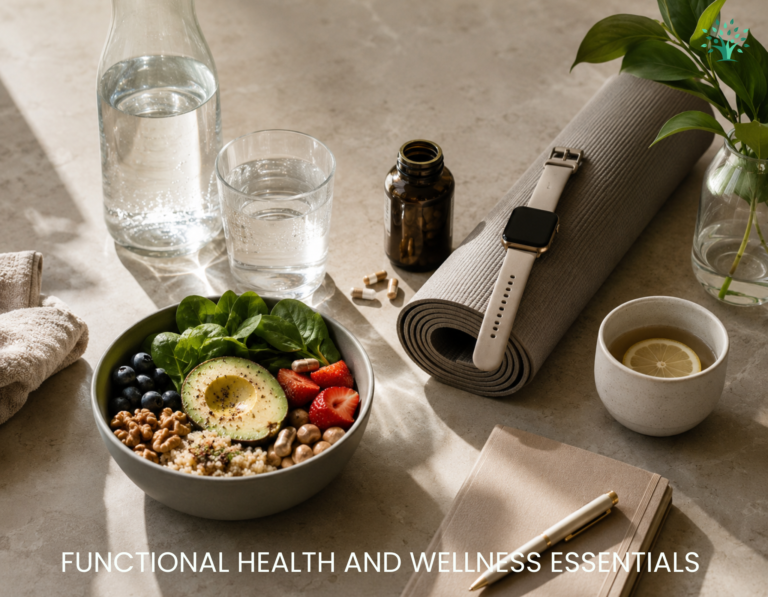
VII. Functional Wellness Essentials
Healthy habits will always form the foundation of wellness, but certain tools can help support consistency when life becomes especially busy.
AG1 Greens Powder Supplement provides convenient nutritional support for days when balanced meals are difficult to prioritize. Electrolytes Powder – Liquid IV helps support hydration, particularly during travel, busy work schedules, or physically demanding days.
For recovery and relaxation, Magnesium Glycinate – Nature’s Bounty remains one of the most widely used wellness supplements. Vitamin B Complex helps support energy production, while Omega-3 Fish Oil supports overall wellness and healthy aging. Many adults also benefit from Vitamin D3 + K2, especially when spending long hours indoors.
To help maintain adequate protein intake, a quality Whey Protein Powder can provide a simple option that fits easily into a busy schedule.
These products are not intended to replace healthy habits. They are tools that work best when combined with consistent sleep, movement, hydration, nutrition, and recovery practices.
Amazon Associate Disclosure: As an Amazon Associate, I earn from qualifying purchases at no additional cost to you.

VIII. Live Well Planner
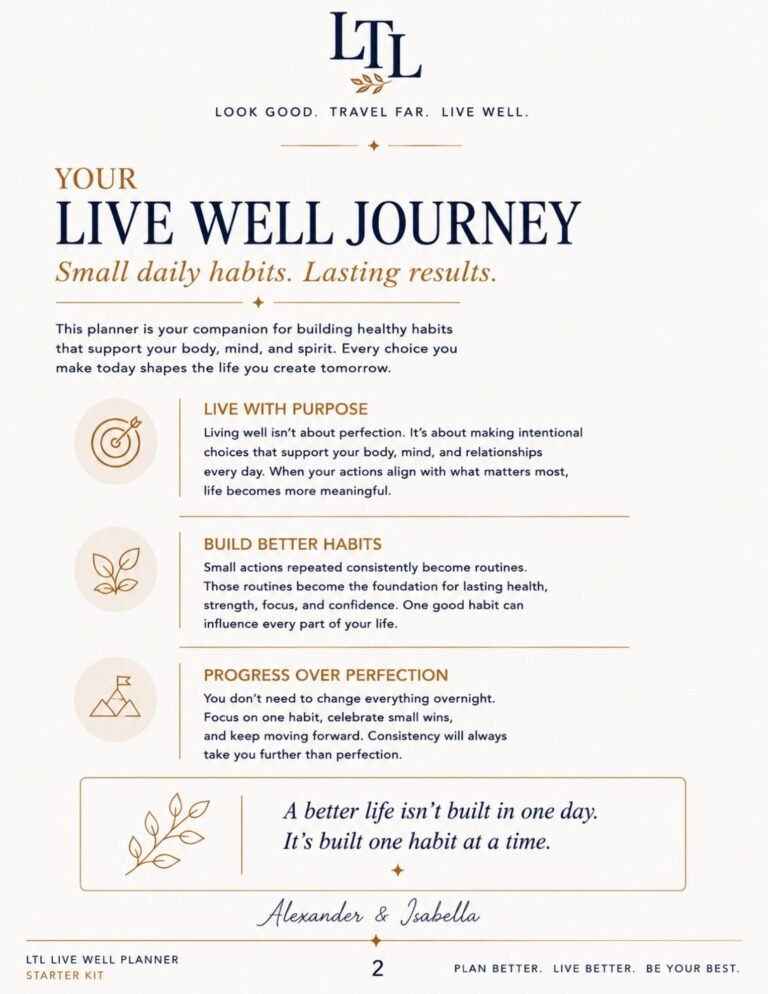
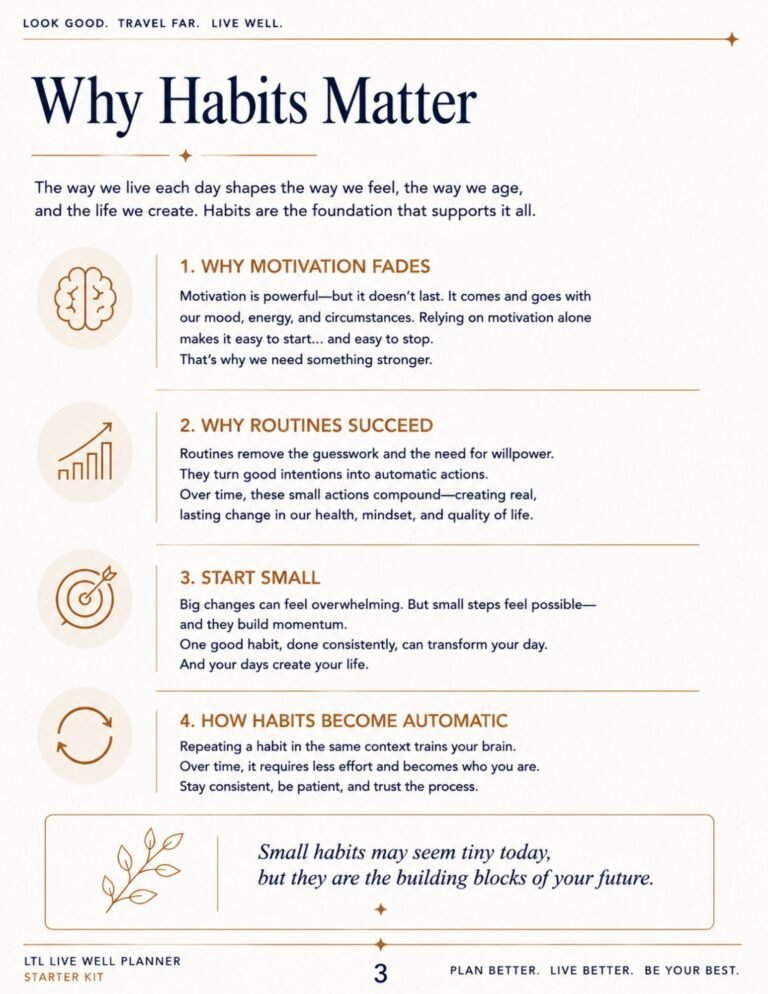
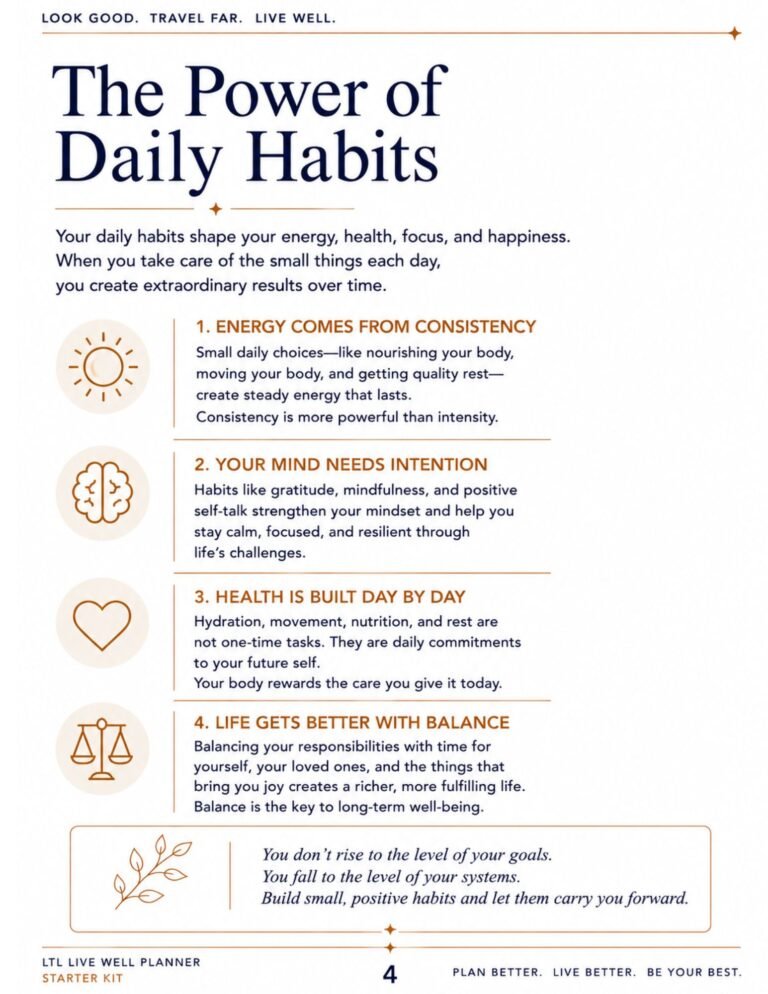
Living well rarely comes from changing everything at once. More often, it’s the everyday habits—how we move, eat, hydrate, sleep, recover, and take care of ourselves—that shape how we feel over time.
That’s one of the reasons we created the Live Well Planner..
The planner provides a simple framework for building healthier routines, staying consistent, and making wellness easier to fit into everyday life.
Inside, you’ll find practical guidance and planning pages focused on:
- Daily wellness habits
- Movement and activity
- Hydration and nutrition
- Sleep and recovery
- Reflection and progress
- Building greater consistency
👉 Get your complimentary “Live Well Planner” 4-Page Sampler. Click here to download.
A selected preview to help you take a fresh look at your daily routine and begin building healthier habits you can realistically maintain.
🛍 The complete Live Well Planner is a 24-page premium LTL Living Guide designed to help you create healthier routines, stay consistent, and make living well part of everyday life.
Small habits. Better days. Live Well.

XI. Functional Health And Wellness For Busy People In Real Life
Functional health and wellness for busy people is not about doing everything perfectly.
It is about doing the important things consistently.
Life will always bring competing priorities. Work becomes demanding. Family responsibilities increase. Travel disrupts routines. Unexpected challenges appear. Waiting for the perfect time to focus on wellness often means waiting forever.
The people who maintain healthy lifestyles are rarely perfect.
They simply return to the basics more often than they drift away from them.
Consistent movement, better sleep, proper hydration, thoughtful nutrition, and adequate recovery continue to form the foundation of long-term wellness.
Those habits may seem ordinary, yet they create the foundation for energy, resilience, healthy aging, and overall well-being.
Wellness is not built in a single day.
It is built through small choices repeated over time.
Busy people do not need perfect routines.
They need sustainable ones.
Live Well.
With care,
Samuel